

The Hidden Cost of Delayed Healthcare: What Rural Indian Families Really Pay
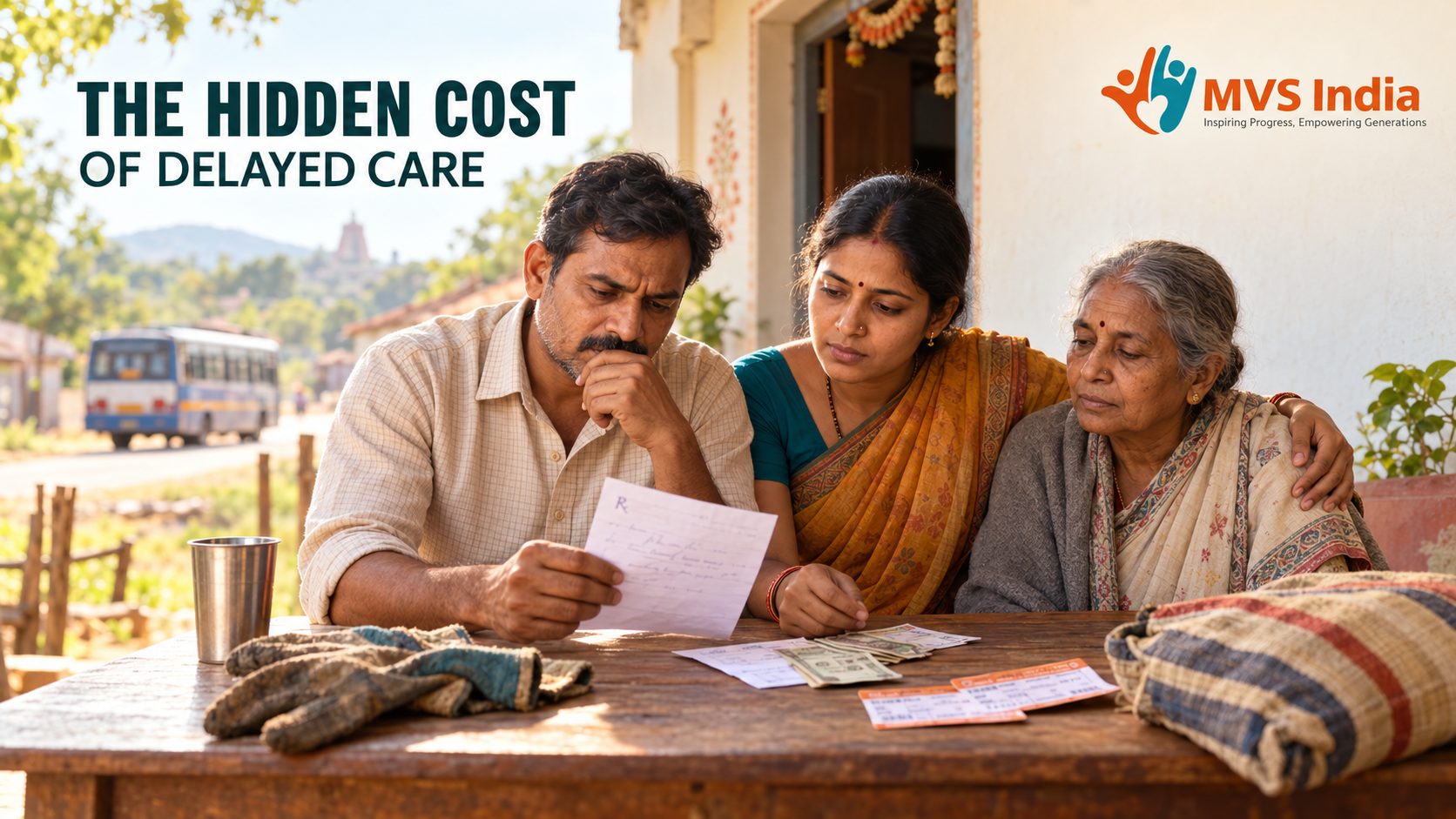
Ask a family in a village how much a health check-up costs, and they will quote the price of a test. Ask them what it really costs, and the answer changes: a day’s wages, the bus fare, a relative who left work to come along, and sometimes a loan taken because the problem was found too late. This gap between the price on the bill and the price a family actually pays is the hidden cost of rural healthcare in India.
India has made real progress in easing the financial burden of health. According to the National Health Accounts estimates for 2021-22, out-of-pocket spending fell to 39.4 per cent of total health expenditure, down from 62.6 per cent in 2014-15, while the government’s share rose to 48 per cent. But these figures only count money that was spent. They do not count the wages that were lost, the workdays that disappeared or the weeks a family waited before seeking care.
At Manav Vikas Sanstha (MVS India), our teams have seen this in village after village. This blog explains what the hidden cost looks like, who carries it most, and why catching health problems early is one of the most practical ways to reduce it.
What Is the Hidden Cost of Healthcare?
When most people think of the cost of healthcare, they think of the direct costs:
- Consultation fees
- Diagnostic tests
- Medicines
- Hospital charges
The hidden costs sit quietly around them:
- Travel to a faraway facility, often more than once
- A full day of lost wages for the patient
- A lost day of work for the family member who accompanies them
- Food and other expenses away from home
- Money paid to informal providers when early symptoms are ignored
- Borrowing, and the interest that follows
- A condition that keeps getting worse while the family waits
None of these appear on a prescription, yet together they can outweigh the cost of the test itself.
What MVS Sees in the Villages
Whenever the MVS team has gone to work in villages, we have seen the same thing again and again. When it comes to health, the problem is not only about treatment. The real problem begins with the basic check-up. Even for basic diagnostics, people in rural areas often have to travel long distances. Sometimes this is not just from one village to the next, but from the village to the district headquarters, and even to a different city altogether.
That journey has two costs.
The first is direct: the money spent on travel and on getting the tests done.
The second, and bigger, is the loss of livelihood. A daily-wage labourer who travels to another city for a check-up loses his entire day, which means losing that day’s wage. A marginal farmer who makes the same trip loses a full day he would have spent working in his field. For families living close to the edge, one lost day is never a small thing.
It was this ground-level reality of our villages that made us certain we needed a solution which brings basic health screening to the doorstep and tackles the problem at its root.
Why Diagnosis Gets Delayed in Rural India
Delay rarely comes from carelessness. It usually comes from a chain of practical barriers:
- Distance:the nearest place for a basic diagnostic test may be far from home.
- Limited services nearby:many primary facilities lack the equipment and staff for even routine screening.
- Lost wages:going for a check-up means a day without earning, so it is postponed until the pain forces a decision.
- Fear of cost:many families assume tests and treatment will be unaffordable.
- Low awareness:conditions like high blood pressure, high blood sugar and anaemia often give no clear warning in the early stage, so people do not think they need a check-up.
- Myths and hesitation:unfamiliar machines and tests can create fear or misconceptions.
When a health problem is found late, treatment is usually longer, harder and more expensive. The delay itself becomes the most costly part.
Meet Dinesh: A Story from the Early Days of Project AAROGYYA
In the early days of Project AAROGYYA, we met Dinesh Like many people in his community, he had never had a proper health check-up. It was not that he did not care about his health. Getting a check-up had always meant and that was a price he could rarely afford.
When the Health ATM was installed at his nearest government health facility, our team went through the community explaining what the machine was, how the tests worked and what the report would show. Dinesh. In about 10 to 15 minutes, he had a report in his hands covering far more than he had ever been checked for before.
What stayed with our team was not the machine. It was the change in Dinesh’s own reaction. For the first time, a health check was something near his home, quick and without the cost of a lost day. Stories like his are why we believe the first health screening should be early, easy and within reach.
The Journey of a Delayed Diagnosis
This is an illustrative example drawn from patterns we see in the field. It is not an account of one real patient.
- A farmer notices tiredness and headaches but keeps working, because a day off means a lost day in the field.
- He tries a local remedy or buys medicines from a nearby shop.
- Weeks pass. The symptoms continue, and he finally decides to get checked.
- He travels to the district headquarters, losing a day of work. A family member goes with him and loses theirs too.
- The first visit is not enough. Tests are advised, and a second trip follows.
- By the time the diagnosis comes, the condition is more advanced, and treatment is longer and costlier.
At every step, the family pays a little more. None of those payments is large on its own. Together they become a heavy burden.
Early Screening vs Late Treatment
The difference between finding a problem early and finding it late is not only medical. It is financial and personal.
When a problem is found early: a basic screening near home takes minutes. The patient can be guided on lifestyle, diet or follow-up. Travel is limited and wage loss is small.
When a problem is found late: the family faces repeated trips, long waits, higher treatment costs and sometimes an emergency. Wage loss is large, and the whole household feels the strain.
Prevention is not just better for health. It is cheaper for families.
Who Pays the Most?
The hidden cost is not shared equally.
- Daily-wage workerslose that day’s income on every trip.
- Marginal farmerslose valuable working days in the field.
- Womenoften put their own health last while managing the household and care of others.
- Older adultsneed more frequent check-ups but find travel the hardest.
In our screenings, high blood pressure, high blood sugar and anaemia are very common. Many people carry these conditions without knowing it. The latest National Family Health Survey (NFHS-5, 2019-21) found that 57 per cent of women aged 15 to 49 in India are anaemic, a reminder of how widespread a silent condition can be.
Why Early Screening Changes the Equation
Early screening works because it moves the first step of healthcare closer to the people who need it.
- It finds risks beforesymptoms become serious.
- It reduces the need to travel for basic tests.
- It gives patients clear information to act on.
- It helps health workers decide who needs urgent care and who needs only guidance.
- It reduces the load on busy doctors and larger hospitals.
When the first check-up happens at the nearest primary health centre, the family saves time, money and worry. This is the idea at the heart of Project AAROGYYA.
How Technology, NGOs and CSR Can Help
Under Project AAROGYYA, MVS India installs Health ATMs in government Primary Health Centres (PHCs) and Community Health Centres (CHCs) with the support of CSR partners. A Health ATM can screen more than 45 health parameters in about 10 to 15 minutes, including blood pressure, blood sugar, ECG, haemoglobin, oxygen saturation, body composition and lipid profile. Reports are available instantly, and patients can receive them digitally or as a printout.
But a machine alone does not change anything. Our team surveys the community first, works with local health officials, trains facility staff and spends time with villagers so that they understand the machine and trust it. In our next blog, we explain in detail what it takes to run rural digital healthcare on the ground.
The Road Ahead
If we want to reduce the real cost of illness in rural India, we have to look beyond the price of treatment. We have to ask how far a family must travel, how many days of work they lose and how late they discover a problem.
Government health systems, CSR partners, NGOs and communities each have a role. When a basic health screening becomes available at the nearest government facility, the whole picture changes. We also need to measure success differently, not just by how many people were screened, but by how many families were spared a long journey, a lost day or a late diagnosis.
Conclusion
The hidden cost of delayed healthcare is paid in lost wages, long journeys, postponed check-ups and late diagnoses. It falls hardest on those who can least afford it. The way to reduce it is simple to state and hard to deliver: bring early, reliable screening close to home, and make sure people trust it and act on it.
Project AAROGYYA is MVS India’s effort to do exactly that, one government health facility at a time.
Healthcare that arrives early costs less, in every sense.
FAQs
- What are hidden healthcare costs?
Hidden healthcare costs are expenses and losses beyond medical bills, such as travel, lost wages for the patient and caregiver, informal treatment costs, borrowing and the cost of the condition worsening.
- Why is diagnosis delayed in rural India?
Common reasons include long distances to facilities, limited diagnostic services nearby, loss of daily wages, fear of cost and low awareness of silent conditions.
- How does early screening reduce healthcare costs?
Early screening finds health risks before they become serious, which reduces repeated travel, emergency visits and expensive late-stage treatment.
- Which health conditions are common in rural screenings?
High blood pressure, high blood sugar and anaemia are very common in the screenings our teams see.
- What is a Health ATM?
A Health ATM is a screening kiosk that checks more than 45 health parameters in about 10 to 15 minutes and gives an instant report.
- How can companies support rural health screening?
Companies can fund Health ATM installations in government PHCs and CHCs through CSR and partner with an experienced NGO such as MVS India to implement and monitor them.

All Categories
- Annual Reports (1)
- News (30)
- Projects (12)
Tags
+0123 (456) 7899
contact@example.com