

Reviving Wastelands Through Community-Led Plantation Initiatives
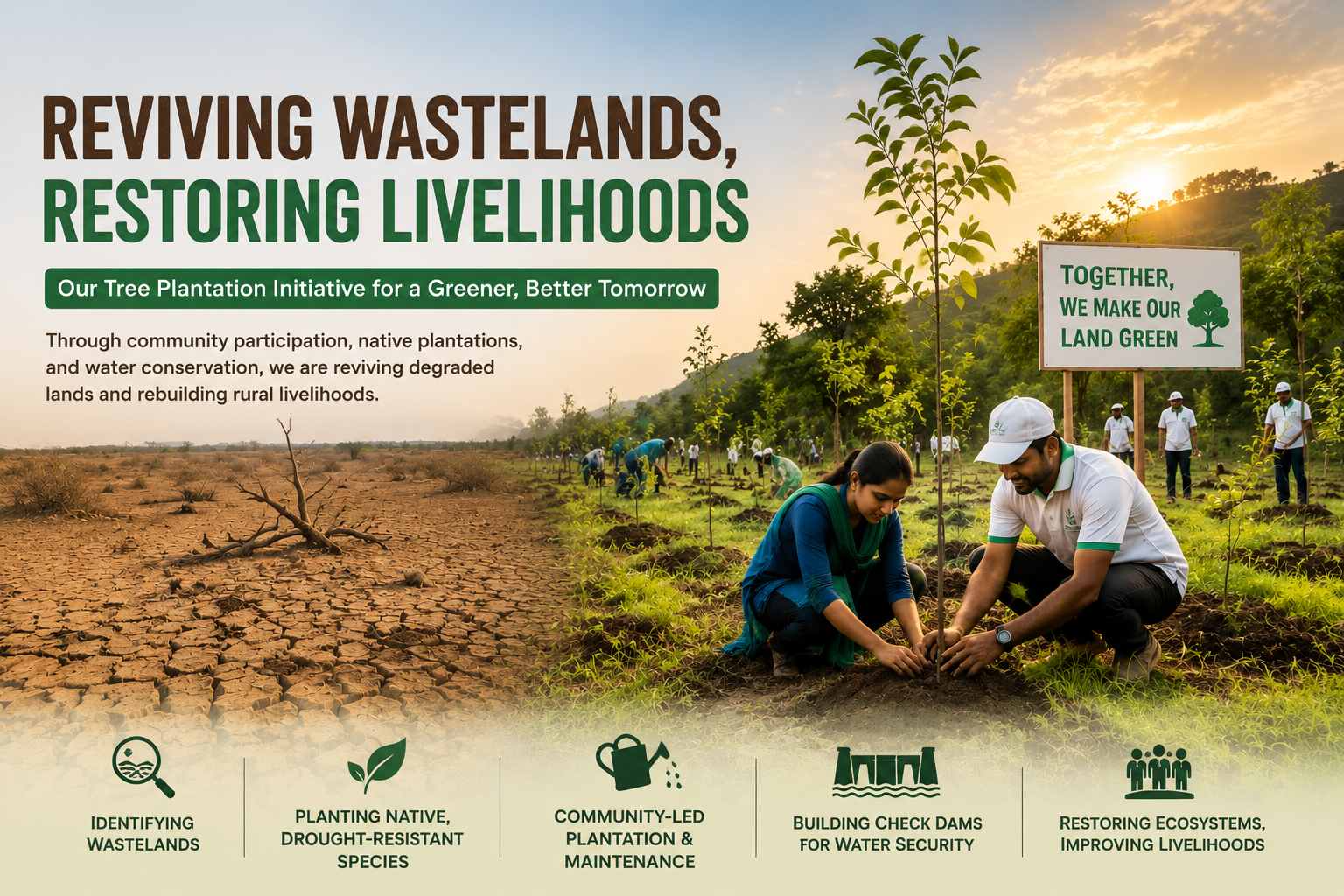
India is currently facing a wide range of environmental challenges, and the growing number of wastelands is one of the key concerns. Due to several interconnected factors, large stretches of India’s rural regions are becoming barren, rendering them unfit to support vegetation or sustain farming. It has severely affected the rural population living near these lands.
In a bid to help the rural population and revive the wastelands, we at Manav Vikas Sanstha (MVS India), a best NGO in India, designed one of our flagship social projects for reviving wastelands through well-planned tree plantation drives. As part of this project, we aim to work on the sustainable development of land through tree planting. If you’re curious about this project and the state of wastelands in India, then you should read the full blog post below.
Growing Wastelands in India: What Created This Environmental Problem?
The growing patches of wasteland aren’t random occurrences. We conducted a close inspection of these areas and found that several interconnected factors have contributed to land degradation across India.
The following are the most common contributors:
-
Deforestation & Vegetation Loss
The excessive removal of trees exposes soil to wind and water erosion over time. It made the land less productive for supporting vegetation.
-
Unsustainable Land-Use Practices
Some lands became wasteland after years of exploitation. Excessive cultivation, improper farming methods, and continuous pressure on natural resources collectively weakened soil health, ultimately degrading land quality.
-
Overgrazing
In many regions, uncontrolled grazing prevented natural vegetation from regenerating. It accelerated land degradation.
-
Poor Water Management
Inadequate water conservation measures left several landscapes vulnerable to droughts, soil degradation, and declining fertility. Over the years, it made the land infertile and unfit for use.
Rural communities have borne the greatest consequences of this ongoing land degradation. Everything from their agricultural practices to their livelihoods has been severely affected by the wastelands.
Can Community-Led Plantation Initiatives Help Revive Wastelands?
It’s one of the most common questions that we at Manav Vikas Sanstha (MVS India) were asked when we started working on our tree plantation project. And in short, the answer to the question is yes. Community-led plantation initiatives can help revive wastelands when implemented strategically. We’ve covered how our project did it in the later section, so read along.
Our team at Manav Vikas Sanstha (MVS India) chose community-led plantation drives as a solution to reclaim wastelands because it can contribute in the following ways:
-
Restoring Vegetation and Improving Soil Health
Trees and native vegetation help stabilise loose soil, reduce soil erosion, and increase organic matter in the ground. With the right tree plantations, we can create land conditions that support healthier and more productive landscapes.
-
Improved Water Retention in the Landscape
Vegetation arising from tree plantation can slow surface runoff, helping the soil absorb and retain moisture more effectively. It contributes to better groundwater recharge, strengthening the land’s ability to withstand dry periods.
-
Creating Ecological & Livelihood Benefits
As degraded land recovers its productivity, rural communities can benefit from improved biodiversity and greater availability of natural resources. As a result, landscapes become better equipped to support sustainable livelihoods.
Reviving Wastelands, Restoring Livelihoods: Here’s How Our Project is Rescuing Wastelands
At Manav Vikas Sanstha (MVS India), one of the top 10 NGO in Jaipur, Rajasthan, we firmly believe that the constant degradation of land is a serious issue because it not only disrupts the ecological balance but also puts rural livelihoods at risk. We wanted to save both, which is why we designed our tree plantation project.
We divided the entire project into four main parts:
-
Site Identification
Our team starts by collaborating with local authorities to identify suitable wasteland areas for tree plantation.
-
Species Selection
Not every tree can survive India’s extreme temperatures. Hence, we thoughtfully chose native, drought-resistant trees that can survive the local climate. We usually choose neem, peepal, bamboo, and amla for most sites.
Even fruit-bearing trees, such as mangoes and guavas, are chosen for plantation as they can support long-term economic benefits.
-
Plantation Activities
Once everything is finalised and people are mobilised, we start the plantation drives. These drives involve everyone, including our ground-level volunteers, local residents, and schools.
-
Maintenance
It’s the most important part of the project. We believe most tree plantation initiatives fail because the planted trees don’t receive the attention and care they need in the first few years. We’ve addressed this problem by collaborating with local people.
Our team develops a maintenance plan that outlines routine watering, weeding, and monitoring saplings’ growth for the first few years and involves local people in the execution. Since these activities instil a sense of ownership in the local community, they actively begin taking care of the trees, which usually leads to restoring the land’s fertility.
Building Check Dams in Shravasti District of Uttar Pradesh to Support Wasteland Revival
Planting trees is only the start of the project; maintenance is what actually keeps such projects going. Since rural families require a constant supply of fresh water to irrigate plants, we collaborated with Konica Minolta to build check dams in the villages of Motipur and Gabbapur Kalan in Shravasti district, Uttar Pradesh.
Although the primary aim of this construction was to address the existing water scarcity problems in the region, it can also be used to water plants regularly. Since these check dams will control water flow effectively, especially during the rainy season and dry months, villagers won’t face water shortages for their agricultural needs and regular plant watering.
Conclusion
Wastelands are a serious problem, but they can be revived with the right solution. At Manav Vikas Sanstha (MVS India), an ISO 9001-2015 (QMS) certified NGO in Rajasthan, we have already started reviving wastelands with our meticulously planned and executed CSR projects.
As we have a PAN-India presence across 19+ Indian states and 60+ districts, we’re trying to reach more wastelands throughout the country that need revival. If you align with this social cause, you can volunteer or donate to our project. You can also collaborate with us to align your CSR project with this cause.
If you’re interested, write to us at hello@mvsindia.org or call us at +91 9549127666/ +91 8955009377.

All Categories
- Annual Reports (1)
- News (31)
- Projects (9)
- Resources (1)


Tags
+0123 (456) 7899
contact@example.com