

How Do Rural CSR Projects Like Canal Lining Improve Everyday Life for Farmers?
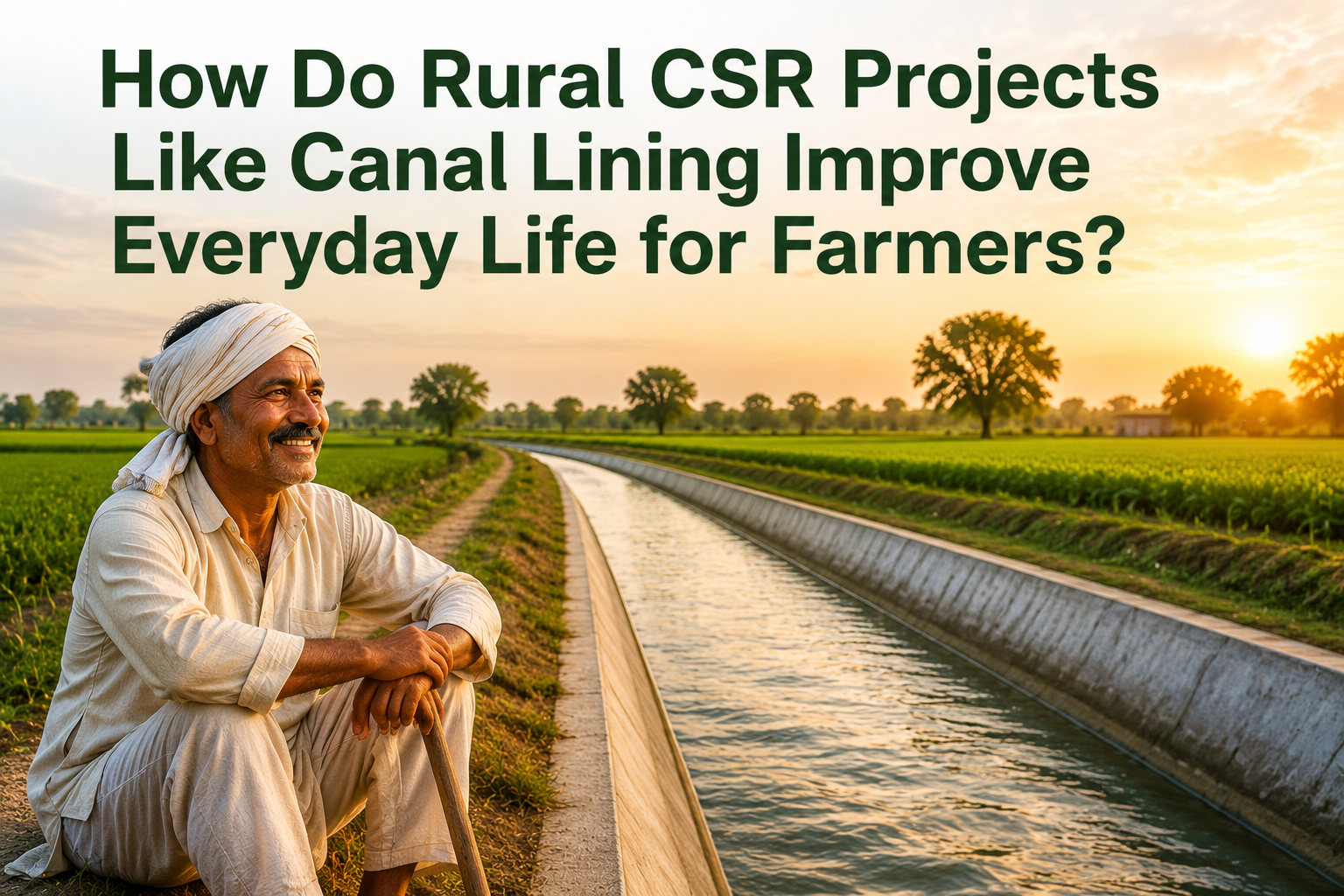
Farmers in rural regions of India often face numerous challenges. While conversations about weather uncertainty affecting their crop production and fluctuating market prices impacting their livelihood have become common, a more crucial issue isn’t getting the attention it deserves.
We’re talking about an inconsistent water supply to their farms. The existing inefficiencies in agricultural infrastructure disrupt the continuous, even water supply to farms, creating additional challenges in farmers’ day-to-day lives. As India’s rural expanse is vast, mere government support may fall short of helping every farmer.
It’s where rural CSR projects undertaken by corporates in partnership with NGOs can solve the problem. In this blog post today, we’ve highlighted how rural CSR projects, such as canal lining, are improving farmers’ everyday lives. You’ll also discover how we at Manav Vikas Sanstha (MVS India), a well-known NGO Working for Agriculture in India, are bringing ground-level improvements in the lives of farmers by partnering with top organisations for rural-development-based CSR initiatives.
The Existing Problems Making Farmers’ Lives Harder
Many rural farmers rely on irrigation canals as their primary source of water for agricultural lands. Since many canals are unlined, significant water is lost to seepage and uneven distribution.
The impact is felt the most by farmers whose agricultural land is located farther along the canal network. By the time water reaches farms at the canal’s tail end, it’s far less than what the farmer needs for agricultural use. It creates a chain reaction of difficulties in their daily farming life, including –
- Uncertain water supply forcing farmers to change their farming plans midway.
- Spending money on diesel or petrol-powered groundwater extraction pumps to address water insufficiency places excessive financial strain on farmers.
- Continuous seepage from unlined canals causes waterlogging in nearby areas, affecting soil quality.
- Lack of enough water can make farmers struggle during critical crop stages
Rural CSR Projects Addressing the Root Cause of the Problem
Rural CSR projects, such as canal lining, are making noticeable efforts to improve farmers’ lives by fixing irrigation infrastructure in underserved areas. At Manav Vikas Sanstha (MVS India), a Jaipur-based NGO, we’ve partnered with numerous top organisations that have chosen to address the practical issues faced by farmers at the community and individual levels through their flagship CSR projects.
Together, we launched Project Jalsamriddhi to facilitate sustainable agriculture practices. One of the methods we used to help farmers was to invest in canal lining. It has significantly reduced water loss and improved irrigation efficiency. If you’re wondering how it has made farmers’ lives easier, then read the following points –
- More water reaches agricultural land, so farmers don’t have to rely on expensive alternatives.
- Reliable irrigation has increased farmers’ confidence, enabling them to make more informed decisions during sowing and cultivation.
- Canal lining has reduced erosion, weed growth, and physical deterioration, thereby better supporting farmers throughout the year.
- Continuous water supply has improved farmers’ productivity and reduced many unwanted daily challenges.
Project Jalsamriddhi: Details You Must Know
We at Manav Vikas Sanstha (MVS India), an ISO 9001:2015-certified NGO in Jaipur, created Project Jalsamriddhi to promote agricultural productivity in rural India. Besides helping farmers by ensuring an uninterrupted and adequate water supply through canal lining, our project also focuses on strengthening the overall rural water security. As a part of our project, we’ve –
- Constructed numerous water conservation structures, including ponds, check dams, and other rainwater harvesting systems
- Undertaken a large-scale tree plantation drive to improve green cover and reduce soil erosion
- Supported multi-crop and climate-resilient farming practices
- Organised awareness programs on sustainable water and agriculture management
We’ve placed special emphasis on canal lining, as many farmers were struggling to continue their agricultural practices without sufficient water. Our canal lining efforts have minimised water seepage problems and ensured efficient and equitable water distribution to farms.
Over time, it has improved irrigation efficiency and crop productivity and supported sustainable agricultural practices.
Haryana Farmers Reap Direct Benefits of Canal Lining
We at Manav Vikas Sanstha (MVS India) recently collaborated with Asian Paints under its flagship CSR project and completed a canal lining project in Rohtak district, Haryana. The primary aim of this project was to enhance water-use efficiency in the area, and we succeeded in achieving it.
Also Read : Role of CSR in Strengthening the Rural School System
As part of this project, we’ve completed 3,000 running meters of canal lining: 2,000 meters in Mor Kheri and 1,000 meters in Gandhara village. This canal lining work improved water flow and reduced seepage, directly benefiting local farmers.
Once the project was finished, farmers expressed their assurance that it would make it much easier for them to access water for irrigation. As we’ve already finished the 3,000 meters of canal lining, Asian Paints announced another 2,000 running meters of canal lining in the region. This additional support aims to further strengthen the region’s agricultural landscape.
Conclusion
Many people don’t think much about canal lining in rural regions, as it’s often viewed through a more technical lens. However, it’s a crucial part of the village’s irrigation infrastructure that directly impacts a farmer’s day-to-day life.
Canal lining ensures that every farmer receives a sufficient water supply to their farmland, making it easier for them to carry out activities such as crop planning, sowing seeds, and applying fertilisers. Besides supporting farming activities, it also eliminates the need to spend money on external water sources and the time spent removing weeds near canal areas.
We at Manav Vikas Sanstha (MVS India), a top NGO in India, are glad to share that around 75+ rural families have benefited from our Project Jalsamriddhi in Haryana alone. We plan to extend our help to rural farmers throughout India. If you want to become a part of this project, you can volunteer with us or donate to our project.
Businesses planning to align their CSR projects with Project Jalsamriddhi can contact us to explore meaningful collaborations. If you’re ready, email us at hello@mvsindia.org. You can also call us at +91 8955009377/ +91 9549127666.

All Categories
- Annual Reports (1)
- News (32)
- Projects (10)
- Resources (1)


Tags
+0123 (456) 7899
contact@example.com