

What It Actually Takes to Implement Rural Digital Healthcare: An NGO’s Ground Guide
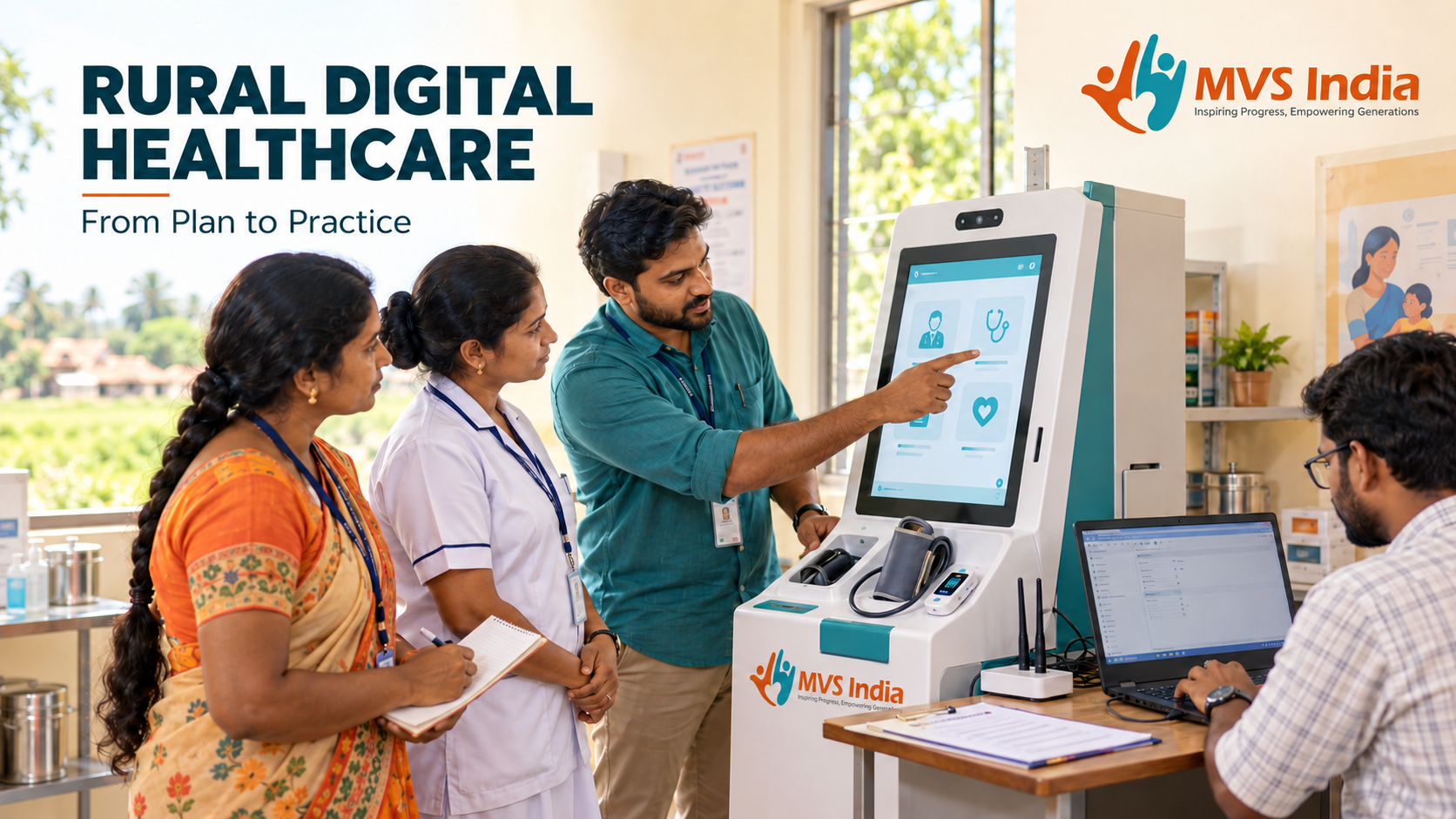
Installing a machine takes a day. Making it work for a community takes a process. Across India, many promising technology projects have ended up unused in a corner, not because the technology failed, but because the people, permissions and follow-up around it were missing. This is true for digital healthcare in rural India more than almost anywhere else.
In our first blog, we looked at the hidden cost families pay when healthcare arrives late. This second blog is about the other side of that story: what an NGO has to do on the ground so that a Health ATM in a government health facility is actually used, trusted and followed up.
It is written for CSR teams who want to know how projects like this are really delivered, and for fellow NGOs who may want to learn from our approach at Manav Vikas Sanstha (MVS India).
What Is Rural Digital Healthcare?
Rural digital healthcare means using technology to bring basic health services closer to people who live far from larger hospitals. It can include screening machines, digital health records, telemedicine and tracking systems for referrals.
Under Project AAROGYYA, MVS India installs Health ATMs in government Primary Health Centres (PHCs) and Community Health Centres (CHCs) with the support of CSR partners. A Health ATM screens more than 45 health parameters in about 10 to 15 minutes, produces an instant digital report and is designed to work with the Ayushman Bharat Digital Mission (ABDM) health ID. It can also keep working offline for three to four days and sync when the connection returns, which matters in places where the internet is unreliable.
Why Technology Alone Is Not Enough
A Health ATM can do a great deal, but it cannot do these things by itself:
- Convince a community that the machine is safe and worth using
- Explain a report to someone who has never seen one
- Make sure a person with a high reading reaches a doctor
- Keep the machine running and the data accurate every day
These tasks depend on people. A good project is not measured by how many machines are installed, but by how many people use them with confidence and how many get the right care afterwards.
The MVS Implementation Playbook: 10 Steps
Behind Project AAROGYYA is the experienced ground team of MVS India. Our process starts with the community, not the machine.
Step 1: Get approval from the health system
We take an approval or recommendation letter from the Chief Medical Officer (CMO) of the district. In some cases, coordination at the CHC and PHC level is needed as well. Working inside the government health system from the start is what allows the project to sit within it and last.
Step 2: Understand the community through a baseline survey
We begin with a basic survey to understand the population of the area, the health problems people face and the current capacity of the local CHCs and PHCs. This sets the baseline against which we later measure change.
Step 3: Bring local voices in
We connect with local health officials, health workers and community leaders, listen to their input and build their support before anything is installed.
Step 4: Select the right locations
We choose CHCs and PHCs using clear criteria: population density, access to healthcare and existing infrastructure. We give preference to deprived and remote areas, because that is where a nearby screening point matters most.
Step 5: Check site readiness
We screen every location first. If something is lacking, such as space, power or connectivity, we ask the local point of contact at the CHC or PHC to arrange it. At every stage, the MVS team guides them on what is needed and how to solve the problems that come up.
Step 6: Install and test
The Health ATM is installed and tested at the facility before it is opened to patients, so that readings and reports work properly from day one.
Step 7: Train the facility staff
The MVS team trains CHC and PHC staff on how to assist patients using the machine, so the facility itself can run screenings and not depend only on outside support.
Step 8: Raise awareness and mobilise the community
After the survey, we first make the community aware that this initiative is coming to their health centre. Then we mobilise people for screening. We help them understand how the tests are done and how to read their reports. If anyone is afraid of the machine or believes a myth about it, we speak to them and answer their concerns patiently.
Step 9: Screen, refer and follow up
People are screened in a guided process. For anyone whose results show a risk, we maintain a tracking system so that every person screened is followed to see whether they received proper treatment. Treatment is the responsibility of the CHC and PHC. Alongside that, the MVS team stays in touch with patients and keeps their details up to date.
Step 10: Maintain, monitor and report
MVS and its partner respond quickly to any problem with a machine. We monitor how each Health ATM is used and how the facility is performing, and we report to partners on a daily basis.
Ground Challenges and How We Solved Them
No project like this runs without problems. Three stood out for us.
- Data collection.Collecting accurate, consistent data from many facilities is harder than it sounds. We built a regular reporting process and a dedicated monitoring and support cell so that numbers are recorded and checked every day.
- Myths about the machine.In many places, people believed that a Health ATM must be costly or complicated, or that the test might harm them. We answered this by spending time in the community, explaining the process, and letting people see others complete a screening safely and quickly.
- Training.Many facility staff had never worked with a screening kiosk. We trained them step by step and stayed available to guide them as they gained confidence.
The common thread was belief. Our team stayed committed to one vision: to make a person’s first health screening better, earlier and easier to reach.
Who Does What: Government, NGO and CSR Partner
A project like this works best when each partner has a clear role.
- Government health system:gives permission and recommendations, provides the facility and staff, and is responsible for treatment and referral care.
- NGO:surveys the community, trains staff, mobilises people, tracks follow-up, supports maintenance and reports progress.
- CSR partner:provides funding, shares the vision and receives clear, regular reporting on results.
When these three work together, the machine becomes part of the public health system and not a stand-alone gadget.
A Due-Diligence Checklist for CSR Partners
If your company is considering a rural healthcare CSR project, these questions can help you judge an NGO’s delivery capacity:
- Has the NGO obtained the right approvals from the district health authorities?
- Does it conduct a baseline survey and need assessment before choosing sites?
- How does it prepare sites that lack space, power or connectivity?
- Who trains the facility staff, and how?
- How does it explain the technology to the community and address myths?
- How are people with risk readings tracked after screening?
- Who maintains the equipment, and how quickly can it respond?
- How often does the NGO report, and what does the report include?
- Does the NGO have the registrations and certifications that CSR rules expect?
An NGO that can answer these clearly has usually thought carefully about delivery.
Measuring What Matters
Counting how many people were screened is a start, but it is not enough. A stronger picture follows the whole journey:
- How many facilities are covered
- How many people were reached and mobilised
- How many were screened
- How many were found at risk and referred
- How many received follow-up and treatment
Because MVS reports to partners on a daily basis and tracks patient details, we can see not only how many were screened but what happened to them afterwards.
How MVS India Approaches Implementation
MVS India is a 25-year-old grassroots organisation with experience across more than 15 states, based in Jaipur. Our teams combine experience from the corporate, government and NGO sectors, supported by a dedicated Monitoring and Support Cell for data analysis, reporting, success stories and impact measurement. MVS is registered under the Rajasthan Societies Registration Act, holds 12A and 80G recognition, is registered with NITI Aayog, is an approved NSDC training partner and is ISO 9001:2015 certified.
Our approach follows a simple chain: participatory need assessment, an integrated work plan, clear implementation strategies, participatory monitoring, measurable outcomes and, finally, partnership for scale and sustainability.
Under Project AAROGYYA, MVS has installed 57 Health ATMs at PHCs and CHCs across multiple districts and states, and has now added 12 more in Bahraich district, Uttar Pradesh, with the support of IDBI Bank’s CSR initiative.
Conclusion
Rural digital healthcare works when technology, people and process move together. Approval from the health system, a clear understanding of the community, well-prepared sites, trained staff, patient follow-up, quick maintenance and honest reporting are what turn a machine into a real health service.
For CSR partners, this means asking not only what technology will be installed, but how it will be delivered. For NGOs, it means staying close to communities long after the installation day.
In our final blog, we share what this approach looks like in practice through the Project AAROGYYA case study.
Technology opens the door. People and process make sure families walk through it.
FAQs
- What is rural digital healthcare?
It is the use of technology such as screening machines, digital records and telemedicine to bring basic health services closer to rural communities.
- Who gives permission to install a Health ATM in a government health facility?
In Project AAROGYYA, we take an approval or recommendation letter from the Chief Medical Officer of the district, and coordinate at the CHC and PHC level when needed.
- Who trains the staff to use the Health ATM?
The MVS team trains CHC and PHC staff on how to assist patients using the machine.
- How are patients followed up after screening?
MVS maintains a tracking system for patients who are screened. Treatment is the responsibility of the CHC and PHC, and our team stays in touch to track patient details.
- Who maintains the machines?
MVS and its partner respond promptly to any problem with the equipment.
- How can a company fund rural digital healthcare through CSR?
A company can partner with an experienced NGO to install and run Health ATMs in government PHCs and CHCs, with clear reporting on screening reach and follow-up.

All Categories
- Annual Reports (1)
- News (30)
- Projects (13)
Tags
+0123 (456) 7899
contact@example.com