

How Does Misinformation About Menstruation Affect Girls’ Health & Education?
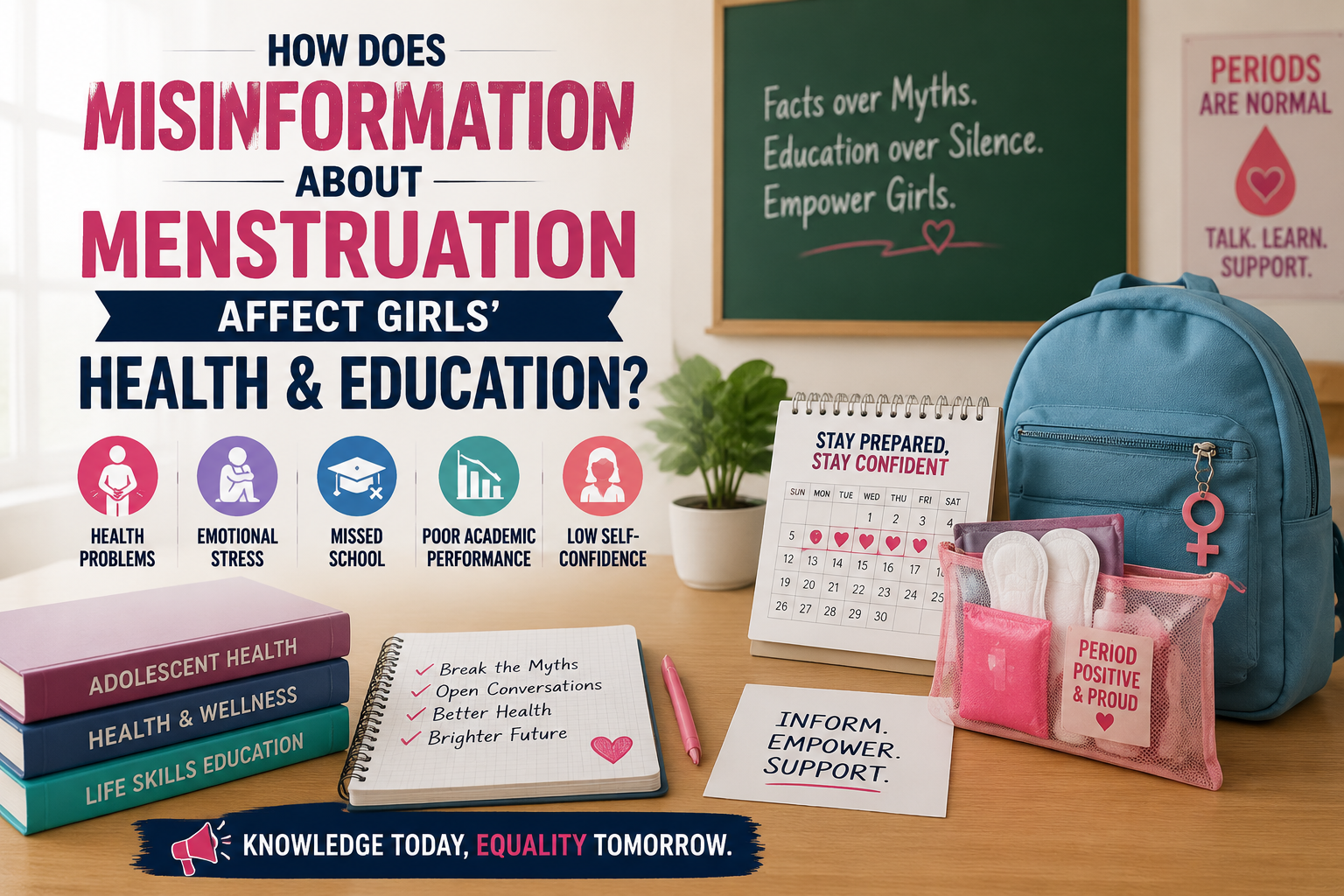
For many girls living in India, particularly in the rural and underserved stretches, the challenges of menstruation begin long before their first period. They begin with the misinformation spread around menstruation.
We at Manav Vikas Sanstha (MVS India), one of India’s leading Jaipur-based NGO working for women empowerment, have witnessed how myths, stigma, and silence around menstruation shape girls’ experiences in ways one cannot imagine. What should have been a natural biological process often becomes a source of fear, confusion, and restrictions. The consequences usually extend far beyond physical discomfort; they begin to affect the girls’ emotional well-being, school attendance, and academic confidence.
Hence, with the intention to help girl students improve their quality of life, especially their health and education, we started Project Garima. We’ve covered more about this project and the issue in this blog post, so make sure you read to the end.
Common Menstruation-Related Misinformation You May Come Across
If you travel to different rural regions across India, you’ll find various pieces of misinformation prevalent due to a lack of proper education. The pieces of misinformation may vary from one region to another, as the socio-economic, cultural, and local environment shapes them. We’re sharing here some of the misinformation we came across on our journey:
- Menstruation is impure.
- Girls should stay away from certain people or places during their periods.
- Physical activities, sports, and exercises are harmful during periods.
- Menstrual pain is always normal and should simply be tolerated.
- Irregular periods don’t require medical attention.
- Talking about menstruation is inappropriate or shameful.
- Menstrual blood is dirty and unhealthy.
- Menstruation is a problem that should be hidden from others.
These are some of the very common myths that have unfortunately been accepted as truth in some regions, especially in the rural areas of India.
Here’s How Menstruation-Related Misinformation Affects Girls’ Health & Education
We just looked at the commonly spread misinformation about menstruation in the previous section. However, since they haven’t been debunked, they continue to affect a girl’s health and education. Here’s how all the misinformation impacts adolescent girls:
-
Delays proper menstrual health & hygiene practices
When girls grow up believing myths instead of facts, they may not learn healthy menstrual hygiene practices.
In many communities, misinformation discourages open conversations, leaving girls unaware of safe product usage, hygiene routines, and signs of potential health concerns that may require immediate medical attention.
-
Increases fear, anxiety & emotional distress
Many girls experience fear and confusion when they first experience menstruation without any prior knowledge. Since many rural girls are told that periods are shameful or impure, it makes them feel embarrassed and self-conscious during menstruation.
Over time, these feelings begin to affect their confidence, self-esteem, and willingness to seek support when needed.
-
Contributes to school absenteeism and learning gaps
One of the most visible consequences of misinformation is missed classroom time. Girls who believe they should avoid school during menstruation, or those who feel judged by peers, may start staying at home during menstruation instead of attending school.
This repeated absence can affect participation, learning continuity, academic performance, and overall educational engagement.
Project Garima: Breaking Menstrual Myths Through Community Efforts
At Manav Vikas Sanstha (MVS India), an ISO 9001:2015-certified women empowerment NGO, we firmly believe that a lot of improvement can be brought about in girls’ lives in rural regions by merely debunking menstruation myths and educating rural communities about it. It’s why we created Project Garima.
Under this project, we provide sanitary pad vending machines and incinerators to select government schools in rural India, so girls can have easy access to quality menstruation products. We’re also providing incinerators alongside sanitary pad vending machines to ensure safe product disposal. It will lower environmental damage by preventing girls from throwing used menstrual products in the open.
Additionally, it will also encourage adolescent girls to continue going to school during their periods, as they no longer have to fear or feel embarrassed while asking for a menstrual pad from a teacher or classmate. They can anonymously take one using the vending machine.
The Working Mechanism Powering Project Garima
The entire team at Manav Vikas Sanstha (MVS India), NGO in India follows a carefully designed structure for smooth project implementation. Here’s how we do it –
- We identify government schools in rural and semi-urban areas with a higher number of female students.
- Once the schools are finalised, we begin with the installation of sanitary pad vending machines and incinerators.
- Our team provides formal workshops on ‘Healthy Menstruation Practices’ for both teachers and students. They’re aimed at ending the stigma and myths associated with menstruation.
- Capacity-building training is also provided to school staff so they know how to operate the vending machines and incinerators.
- We regularly monitor and evaluate the use of the machines we provide to ensure they’re used correctly.
This process has helped us empower girls at multiple levels. Besides improving their overall menstrual hygiene, it has also increased their school attendance and academic participation.
70 Government Schools in Rajasthan Got Sanitary Pad Vending Machines & Incinerators
MVS India collaborated with several leading organisations, including the National Internet Exchange of India (NIXI), CONCOR, RAILTEL, IRCON, and Amazon. Together, we installed sanitary pad vending machines and incinerators in multiple government schools across India.
We’ve already installed these machines in Sahrod, Sheokar, Jarela, Khopar, Kasba Thana, and Deori districts in Rajasthan. We’re currently working to expand our reach to all rural government schools across India.
Conclusion
Menstruation is a natural biological process, and it should be treated as such. Attaching factually incorrect and harmful myths to menstruation not only affects the health of adolescent girls but also influences their academic and personal lives.
The widely spread misinformation around menstruation may also make some girls believe that periods are impure and should not be discussed openly. It may prevent them from asking for help during such times. As a result, they may isolate themselves and begin to miss school. At Manav Vikas Sanstha (MVS India), one of the most widely trusted NGO working for women empowerment in India, we’re using Project Garima to address all these myths so that adolescent girls no longer have to face these challenges.
If you resonate with our aim behind Project Garima and wish to make any contribution toward it, feel free to connect with us at +91 8955009377/ +91 9549127666 or hello@mvsindia.org.

All Categories
- Annual Reports (1)
- News (33)
- Projects (10)
- Resources (1)
Tags
+0123 (456) 7899
contact@example.com