

Why Rural Education Determines India’s Real Growth Story?
Introduction
India’s growth is often discussed through the lens of cities. Hence, growth discussions are mostly centred on expanding metros, scaling industries, and climbing GDP numbers. But if you want to explore India’s real growth story, you cannot ignore rural participation.
As of 2025, nearly 63% of India’s total population lived in rural areas. It means that the majority of India’s future workers, consumers, and citizens are being shaped not in urban classrooms, but in rural India. Hence, the quality of education they receive will determine whether India’s growth is broad-based and resilient or narrow and uneven.
At Manav Vikas Sanstha (MVS India), a 25-year-old, ISO 9001-2015 (QMS) certified NGO in Jaipur, we’re working closely with local leaders in 60+ rural districts to improve the quality of education. These grassroots efforts aim to improve the rural education landscape, ultimately strengthening India’s economic future. If you’re curious about the relevance of rural education in India’s real growth story, read the full blog post below.
Rural Education: The Backbone of India’s Real Growth
For a large part of India’s population, schooling doesn’t take place in well-equipped urban campuses. It happens in government schools across villages and small towns. These classrooms shape the country’s future workforce long before conversations about skills, jobs, or innovation even begin.
When rural education works well, children develop more than literacy and numeracy. They build the confidence and skills needed to participate in income-generating activities, contributing to India’s overall growth trajectory. If rural education doesn’t work well, a major part of the population remains stuck in low-income jobs with limited purchasing power. It eventually weakens and slows the country’s growth.
Faultlines in India’s Rural Education Landscape
Step into a government school in any rural area, and you’ll notice the problems even before anyone mentions them. Classrooms with peeling walls and dim lights, children sharing benches due to a lack of desks, and toilets that are unusable in reality are a few common scenarios in some government schools in rural districts.
These conditions make it difficult for kids to continue their learning journey. The challenges are bigger for adolescent girls. The lack of clean toilets or places to manage menstruation privately prevents them from attending school.
This absenteeism often leads to dropping out of school permanently, not because they don’t want to learn, but because the environment makes learning difficult. Even teachers struggle to work within these limitations every day. Managing overcrowded classrooms and teaching without relevant resources is their daily reality. All these gaps overlap and reinforce one another, slowly eroding learning outcomes and students’ confidence.
What Manav Vikas Sanstha (MVS India) is Doing to Fix the Rural Learning Environment?
Schools in rural locations need more than regulatory support. They need active assistance with improving their infrastructure and resource needs. It is precisely what Manav Vikas Sanstha (MVS India) is helping them with.
Manav Vikas Sanstha (MVS India), a registered member NGO of NITI Aayog, BSE Samman, NGO Box & Goodera and an Approved Training Partner of NSDC, has launched dedicated initiatives, such as Project Vidhya and other on-ground activities, to equip rural schools with the appropriate resources for delivering quality education to all kids. As a highly trusted NGO in Jaipur, we work closely with school authorities, local leaders, and ground-level volunteers to remove common obstacles that usually disrupt the learning journey of children in rural areas.
Over the years, we’ve enhanced the learning environments of numerous schools by providing them with relevant teaching equipment, renovating poor school infrastructure, and delivering hygiene support, among other initiatives. Not only did it bring more students back into schools, but it also reduced absenteeism and dropout rates. These efforts also helped teachers by giving them the relevant Teaching Learning Materials (TLMs), enabling them to improve their teaching methods.
Project Vidhya – An Initiative to Enhance India’s Rural Education Framework
At Manav Vikas Sanstha (MVS India), we have launched numerous initiatives to improve the learning environments in rural schools. Project Vidhya is one of our hallmark initiatives designed exclusively to enhance school infrastructure and improve the learning environment.
The project is in line with some of the major Government of India’s initiatives like Samagra Shiksha, Beti Bachao Beti Padhao, and Swachh Bharat Abhiyan, focusing on holistic education, empowerment of girls, and sanitation, and covers a wide-ranging improvement plan. The goal is to fix poor classroom conditions, improve outdated facilities, build adequate sanitation facilities, provide the necessary learning resources, and spread hygiene awareness.
Hence, with Project Vidhya, Manav Vikas Sanstha (MVS India) is not only aiming to improve classroom facilities in rural schools but also ensuring access to clean drinking water and safe sanitation, fostering community involvement, and much more, so that children can benefit in multiple ways from a healthy learning space.
Real World Impact of Manav Vikas Sanstha’s (MVS India) Rural Education Initiatives
Some of the key challenges with most Government schools in rural regions across India include inadequate infrastructure and poor hygiene facilities. These issues have been consistently adding to school dropouts of girl children.
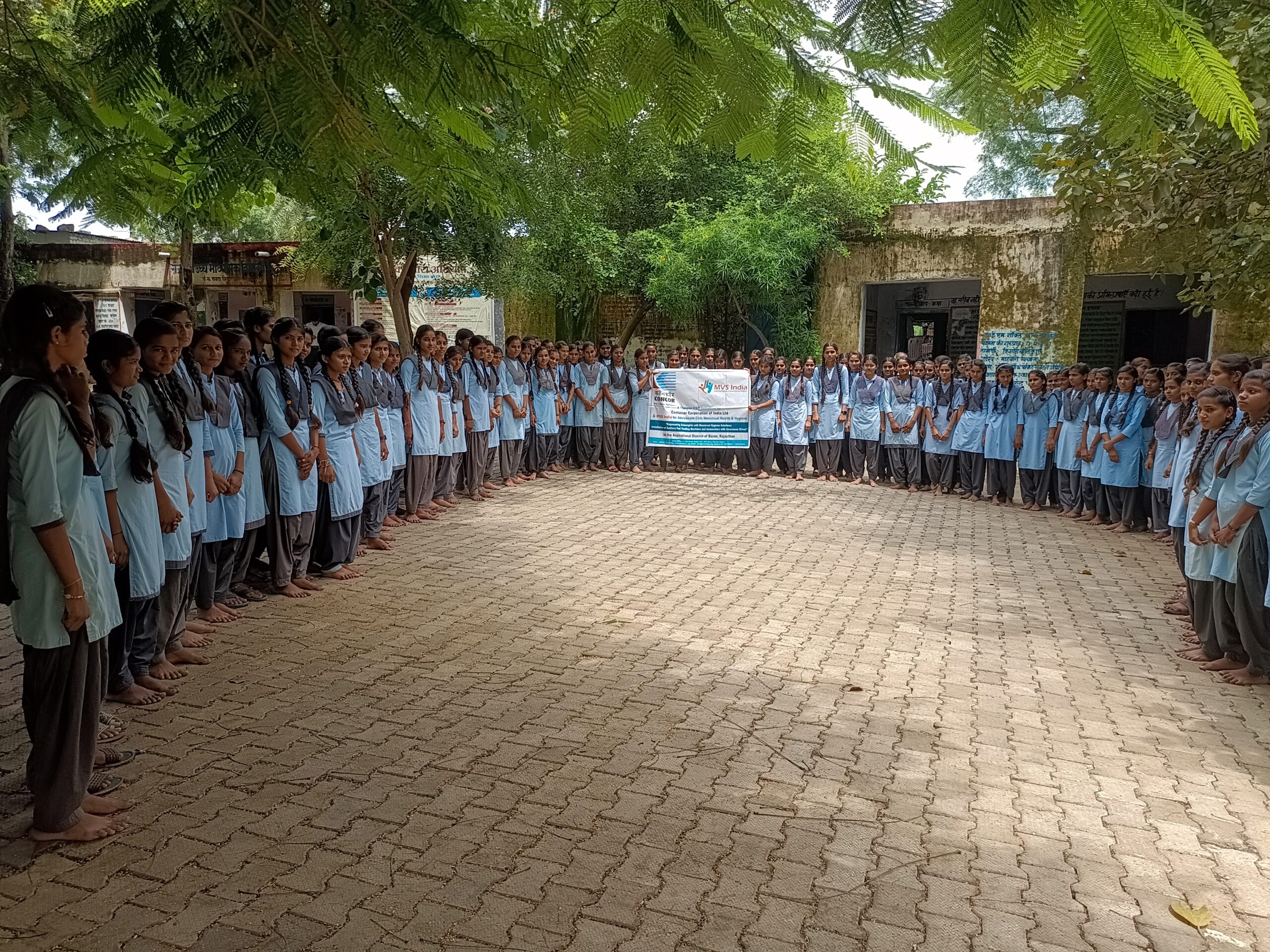
To help improve the condition, Manav Vikas Sanstha (MVS India) took the initiative to install sanitary pad vending machines and incinerators at various schools across different villages in Barmer district, Rajasthan. These installations increased school attendance among adolescent girls and improved their overall health. The school authorities also noticed an improvement in their overall academic performance.
Besides schools in Rajasthan’s rural districts, Manav Vikas Sanstha (MVS India) is also working closely with remote schools in Uttar Pradesh, Assam, Jammu & Kashmir, Punjab, Gujarat, Goa, Sikkim, and numerous other Indian states and union territories to bring nationwide improvements.
Manav Vikas Sanstha (MVS India) has so far reached 60+ districts across India and improved 25+ million lives with its initiatives and CSR projects. With firm belief in improving lives through their grassroots-level efforts, Manav Vikas Sanstha (MVS India) is giving a noticeable boost to the quality of education delivered in rural schools, eventually equipping the rural population to contribute meaningfully to their own as well as the country’s growth.
Conclusion
A country can only grow when a major part of its population grows together. For countries like India, where a significant portion of the population still lives in rural locations, the growth story will always remain incomplete without prioritising the rural education landscape.
Manav Vikas Sanstha (MVS India), a well-known NGO in Jaipur, is working closely with key community members, local leaders, and other stakeholders in rural regions to build dependable education spaces, where learning quality and environment are on par with those of their urban counterparts. We firmly believe that when rural schools are safe, inclusive, and well-equipped to provide quality education, they contribute to real, long-term national growth. This belief lies at the heart of our work.
If you share this vision of strengthening India from the grassroots and want to become a part of the change, you can support our initiatives through volunteering, partnerships or contributions. Every helping hand can bring hundreds of rural children closer to quality education and a better future.
To connect, write to us at hello@mvsindia.org or give us a call at +91 8955009377/ +91 9549127666.

All Categories
- Annual Reports (1)
- News (21)
- Projects (9)

Tags
+0123 (456) 7899
contact@example.com