

Water Scarcity is a Daily Reality for Many Communities Across India
Overview
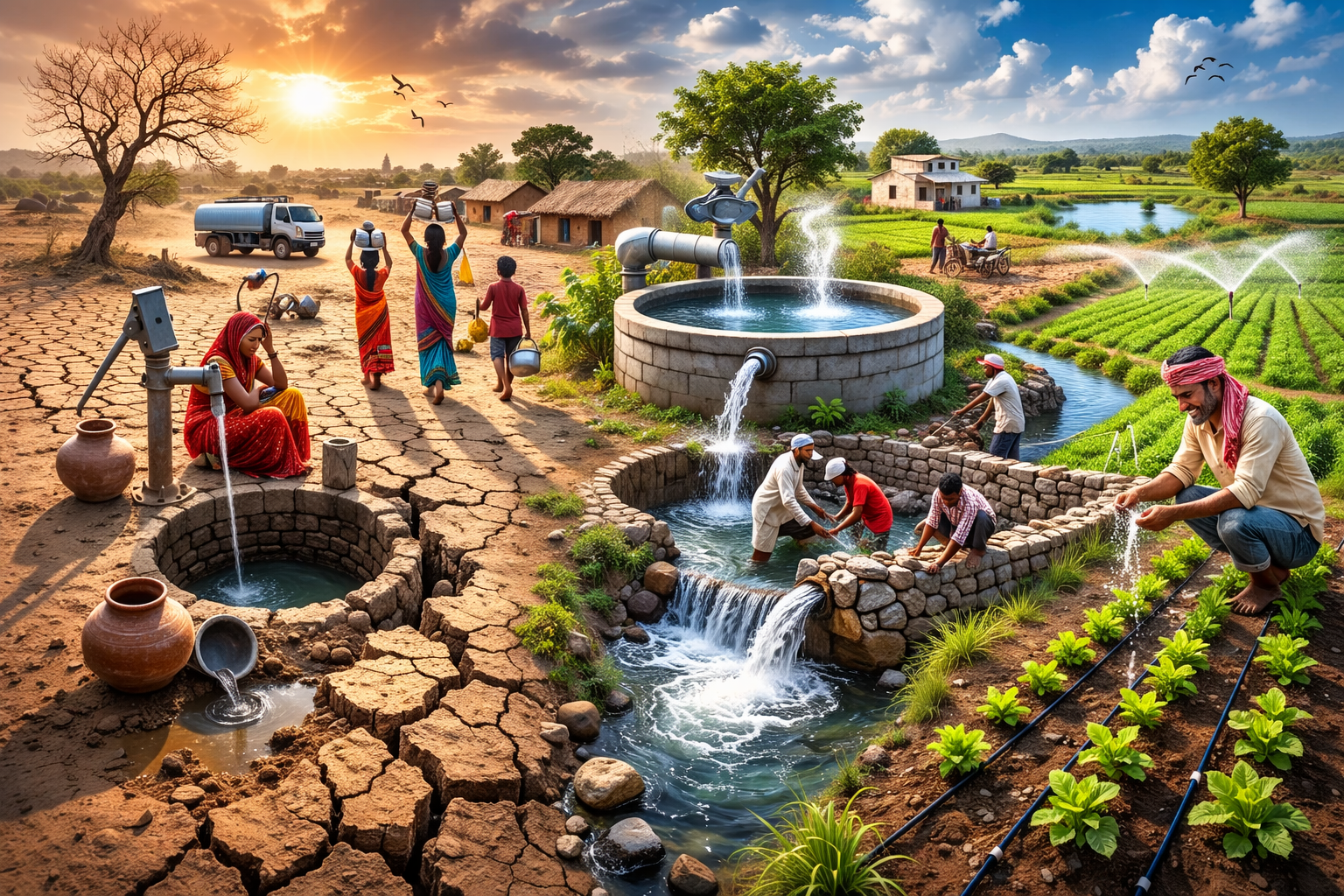
Water scarcity in India is often discussed as a future problem. Yet, for many communities across India, especially in rural regions, it is already part of people’s daily lives.
People living in villages, towns, and even some cities adjust their routine around the availability of water. They adjust their routine to ensure the timely collection of water from tankers, wait for municipal supply hours, and even walk long distances to wells and ponds. A single factor doesn’t create this reality. Instead, it has emerged from a combination of environmental pressures, changing water-use patterns, and gaps in water management.
This water scarcity isn’t just affecting people’s quality of life, but also making it challenging for farmers to grow crops that require substantial water. Although the government is doing its bit, our team at Manav Vikas Sanstha (MVS India), one of the Top Environmental NGOs in India, is conducting numerous ground-level initiatives to curb water scarcity PAN India. Read the full blog post to explore more about the water scarcity problem in India and what efforts we are making to help curb the issue.
The Real Contributors of Water Scarcity in India
If you visit a remote, rural village, the signs of water scarcity will become instantly visible. From wells drying up to a limited supply of drinkable water, you can witness it all. If you’re wondering what led to such water scarcity in India, the answer lies in the following points:
-
The silent depletion of groundwater
One of the key reasons behind water scarcity in villages is the heavy dependence on groundwater. Millions of households in rural areas depend on groundwater from wells and borewells as the primary source of drinking water and irrigation.
This dependence has resulted in over-extraction of water. As agriculture and borewell technology became more accessible, groundwater was pumped out faster than it could naturally recharge.
Hence, water tables have steadily fallen in many regions, forcing communities to dig deeper wells or depend on increasingly unreliable water sources. We at Manav Vikas Sanstha (MVS India) are working to ensure a steady water supply for people by constructing water conservation structures, such as rainwater harvesting systems, check dams, and dugout ponds at the farm and community levels.
-
Agriculture’s enormous water demand
Agriculture plays a key role in India’s economy and food security, but it’s also the largest consumer of water. A significant portion of the country’s freshwater resources is used to irrigate crops, particularly water-intensive crops, such as rice, wheat, and sugarcane.
In regions where irrigation relies on groundwater, farming practices can place immense pressure on aquifers. As irrigation demand rises, local water sources are stretched beyond sustainable limits. The result is a gradual but persistent decline in water availability.
Our ground-level team at Manav Vikas Sanstha (MVS India) is trying to tackle this challenge by spreading awareness among the rural population about the importance of sustainable water management and agriculture practices.
-
Dependence on an unpredictable monsoon
India’s water system is deeply tied to the monsoon. Most of the country’s rainfall arrives during a few months of the year, replenishing rivers, reservoirs, and underground aquifers.
Since climate variability has started to disrupt this pattern, rainfall has become more irregular in both timing and distribution. As a result, the water availability has reduced significantly.
Fixing India’s Water Scarcity with Project Jalsamriddhi
The water scarcity problem can only be solved sustainably if one addresses its root causes. It is exactly what we at Manav Vikas Sanstha (MVS India), a highly trusted NGO in Rajasthan, are striving to do through our Project Jalsamriddhi.
We launched Project Jalsamriddhi to strengthen rural water security and promote sustainable agricultural productivity, thereby limiting water waste on crops. As part of this project, we’re constructing water conservation structures, including dugout ponds, rainwater harvesting systems, check dams, pond rejuvenation, and canal lining. We’re also working to enhance groundwater recharge to ensure long-term water stability in villages.
Here’s a quick glimpse of what we’re doing under the Project Jalsamriddhi to tackle water scarcity:
- Setting up rainwater harvesting structures at the farm and community levels
- Ensuring efficient water usage by encouraging the use of micro-irrigation systems (drip and sprinkler)
- Educating farmers on the adoption of water-efficient crop practices and planned irrigation scheduling
- Implementing watershed management projects to enhance water retention and soil conservation
- Investing in canal lining to minimise water loss due to seepage
These are a few activities we’re conducting PAN India to reduce water wastage and increase groundwater recharge.
Real Efforts = Real Improvement
At Manav Vikas Sanstha (MVS India), we believe in creating real-world impact. This is why our projects don’t just look good on paper but also reach the ground level for visible impact.
For instance, we collaborated with Konica Minolta Business Solutions India, Pvt. Ltd. and the DS Group to construct water-harvesting structures in Shravasti district, Uttar Pradesh. Under this collaboration, we installed newly constructed check dams to harness and store rainwater. This construction benefited over 6,868 individuals in the region.
We’re also working closely with Asian Paints to enhance water use efficiency in the Rohtak district of Haryana. This is an ongoing project in which we’re working with the local community to enhance water-use efficiency through canal lining. This project is expected to benefit nearly 70-90 farm families.
Conclusion
Water scarcity is a concerning reality of many rural communities across India. If efforts are not made to tackle it sustainably, people may struggle to obtain an adequate amount of drinking water.
We at Manav Vikas Sanstha (MVS India), being one of the Top Environmental NGOs in India, are working tirelessly to address water scarcity across 19+ Indian states and union territories through our Project Jalsamriddhi. If you also want to contribute to our efforts to minimise water scarcity challenges in rural communities, you can volunteer with us and be a part of the project. Corporates can also partner with us to design new water scarcity-prevention programs as part of their CSR projects. Write to us at hello@mvsindia.org or give us a call at +91 8955009377/ +91 9549127666.

All Categories
- Annual Reports (1)
- News (22)
- Projects (9)

Tags
+0123 (456) 7899
contact@example.com