

Solar Power as a Catalyst for Social and Economic Development
Overview
The headlines about village electrification can make most believe that villages receive the same steady supply of electricity as people in metro cities do. However, the reality can be surprising as you visit rural villages to witness the actual implementation.
Although villages have connections to the main electricity grid, they do not receive a reliable power supply due to various factors, such as frequent outages, voltage fluctuations, and limited supply hours. Such on-and-off electricity access causes far more than inconvenience to rural households and businesses; it restricts education and mobility and puts extreme financial pressure on low-income families through high energy bills.
Since government initiatives alone may fall short due to India’s vast rural expanse, Manav Vikas Sanstha (MVS India), one of the top 10 NGOs in Jaipur, is making grassroots efforts to provide a steady, continuous supply of electricity for both social and economic development in rural regions.
In this blog post today, we introduce you to the unique power challenge rural India faces and how our social projects are helping bring tangible improvements in people’s lives.
The Reality of Power in Rural India
While rural electrification has expanded across India, reliability remains a persistent concern. Many villagers face irregular power supply, unexpected outages, and inconsistent voltage. All of it makes electricity difficult to depend on for daily or productive use. This uncertainty affects most essential services.
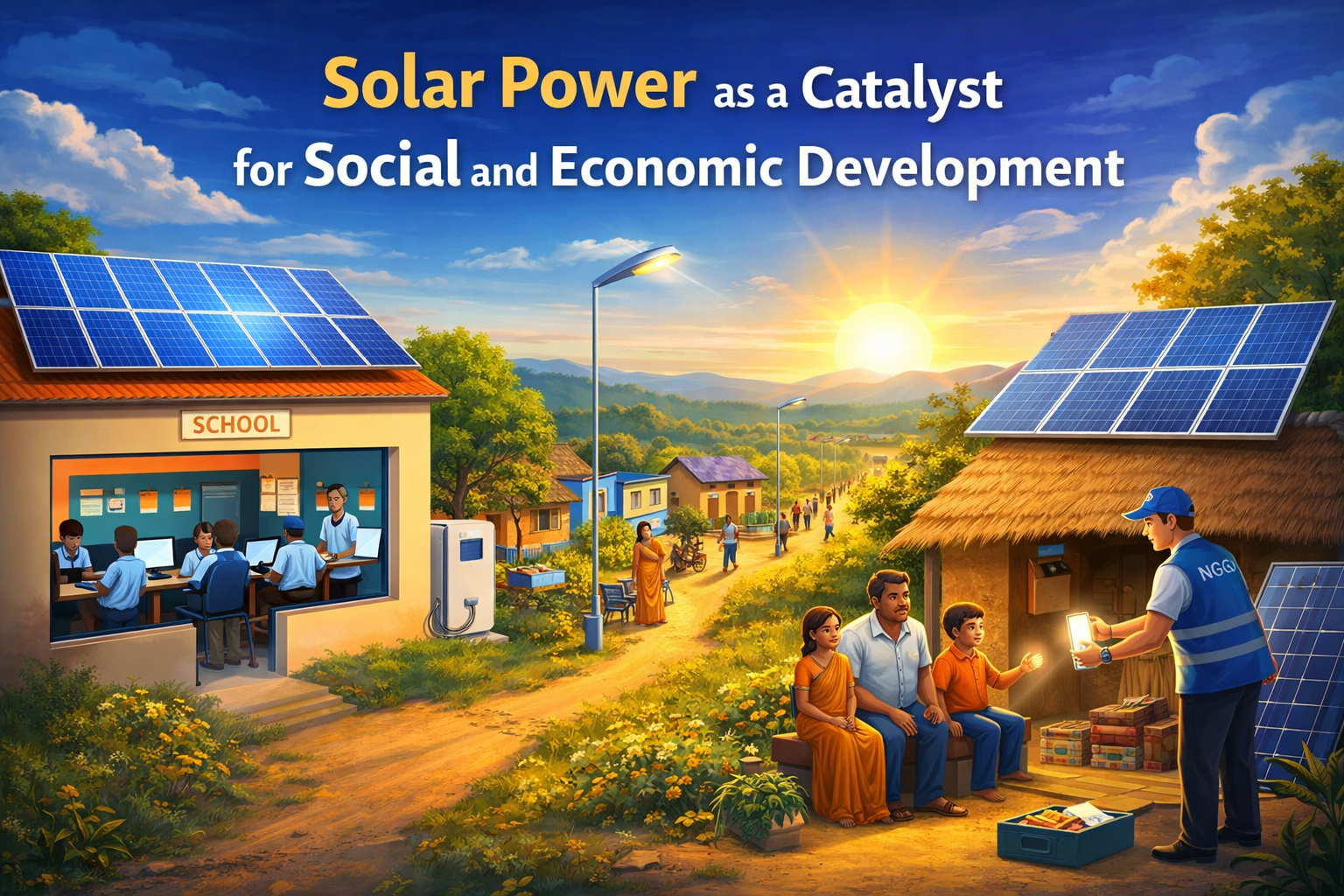
Schools in rural areas struggle to provide quality education to students because an inconsistent power supply makes it difficult to use laboratories, computers, and other digital learning aids.
Even local businesses are forced to close their shops early because there is no reliable power supply to illuminate the roads during dark hours. Women, children, and the elderly also experience restricted mobility in the evening for the same reason.
Stable Energy Access Can Shape Rural Development
For years, we’ve witnessed energy poverty resulting in limited opportunities across rural villages. It restricts the ability of individuals to improve their livelihoods and of communities to grow economically. Reliable electricity is what rural India needs to move from subsistence living to productive participation in the broader economy.
After all, electricity is not just a utility; it’s the foundational enabler of development. At Manav Vikas Sanstha (MVS India), we believe that a consistent power supply stands as the key solution in this regard, as it not only helps facilitate quality education for rural children but also empowers the local businesses to scale their operations by extending their work hours.
Without it, development will continue to remain uneven and incomplete. Hence, we’ve created a project that bridges the gap between people and stable power through solar energy installations. We’ve covered more about this project in the later sections of this blog post.
Solar Power: A Practical Solution to Providing Steady Power in Rural Villages
We at Manav Vikas Sanstha (MVS India), one of the leading ISO 9001:2015-certified environmental NGOs in India, firmly believe that solar power is the solution to rural electricity challenges because most rural regions receive abundant sunlight most of the year. This abundant sunlight exposure can be used to generate massive volumes of electricity without depending on centralised grids.
Once solar power systems are installed, villagers can reduce their dependence on distant power infrastructure. Solar power solutions can provide a more predictable, steady energy supply than grid connections can. They can also be scaled based on village needs, making them both adaptable and cost-effective.
Empowering Rural Lives through Our Clean Energy Project
We at Manav Vikas Sanstha (MVS India) have initiated a solar energy project to ensure reliable, steady energy access for rural villages across 19+ Indian states and union territories.
This project is designed to improve rural villages’ educational infrastructure and community safety, and to contribute to overall social and economic growth. Here’s a quick glimpse into what we’re aiming to do under this project to bring ground-level improvements.
-
Installing 10 kW Off-Grid Solar Power Systems in Government Schools
We’re installing 10 kW off-grid solar photovoltaic systems with battery storage solutions in select government schools in rural villages. This solar installation will aid the schools in powering their classrooms, laboratories, computer rooms, and other areas throughout school hours.
The project also proposes to install solar inverters and train school staff on system operation and basic maintenance. This effort aims to reduce the dependence of schools on grid electricity, paving the way to improve digital education and the overall learning environment.
-
Installation of Solar Lights in Villages
Under our solar energy project, we at Manav Vikas Sanstha (MVS India) are also working on installing standalone, high-efficiency LED solar street lights with dust-to-dawn operation in priority locations across villages. These installations are primarily being made at main roads, school routes, markets, health centres of villages, etc.
This installation aims to improve the safety and security of women, children, and the elderly during the night hours, enabling greater mobility. It will also reduce road accidents and crime risks, which are more likely to occur in poorly lit or completely dark areas.
-
Distributing LED Bulbs to Low-Income Households
The project also encompasses distributing energy-efficient LED bulbs (9W-12W) to village households, particularly those from the Below Poverty Line (BPL) and low-income categories. Using these bulbs instead of regular lighting sources will help families save money by reducing energy consumption by up to 50-70%. It will also improve their indoor lighting quality and reduce their carbon footprint.
Conclusion
Rural India can benefit immensely from a steady, uninterrupted power supply. While traditional electrification means can also help villagers, we at Manav Vikas Sanstha (MVS India), recognised among the top 10 NGOs in Jaipur, believe that solar power is a better energy alternative for rural regions because of their vast expanse and abundant availability of sunlight throughout most months.
Solar power won’t just provide electricity to villagers, but it will also remove one of the most fundamental barriers to rural development. Once rural villages start receiving reliable, localised energy, it will enable both economic and social progress simultaneously.
If you’re willing to help rural villages receive a steady power supply, you can volunteer with our team or donate to our cause. You can also partner with us to create solar power CSR projects that deliver sustainable, measurable change across villages. If interested, you can call us at +91 8955009377/ +91 9549127666 or email us at hello@mvsindia.org.

All Categories
- Annual Reports (1)
- News (22)
- Projects (9)
Tags
+0123 (456) 7899
contact@example.com