

Corporate-NGO Partnerships Are the Future of Social Development: Here’s Why!
Overview
Social development efforts are no longer new to India. Governments, NGOs, corporates, and other community-level organisations have been carrying out several social development initiatives for decades. However, despite the continued efforts, the desired results aren’t always achieved when everyone works in isolation. This fragmented approach creates roadblocks that prevent organisations from fulfilling the set goal.
While independent NGOs manage to achieve noticeable improvements, their lack of funding forces them to cease operations midway. Similarly, corporates have substantial capital to run their social development initiatives. Still, their limited ground-level presence and lack of trust among local communities lead to resistance, resulting in stalled or unsuccessful projects.
If the country wants to achieve lasting social development, organisations with complementary strengths must collaborate. This is where the coordinated role of NGOs in sustainable development and that of corporates in mobilising financial resources and strategic planning through CSR initiatives becomes crucial. In this blog post today, we at Manav Vikas Sanstha (MVS India), a 25-year-old Jaipur-based NGO, are shedding light on how corporate-NGO partnerships can bring about sustained social development and why they’re the future. Read till the end.
Corporate-NGO Partnerships: A Sustainable and Scalable Model
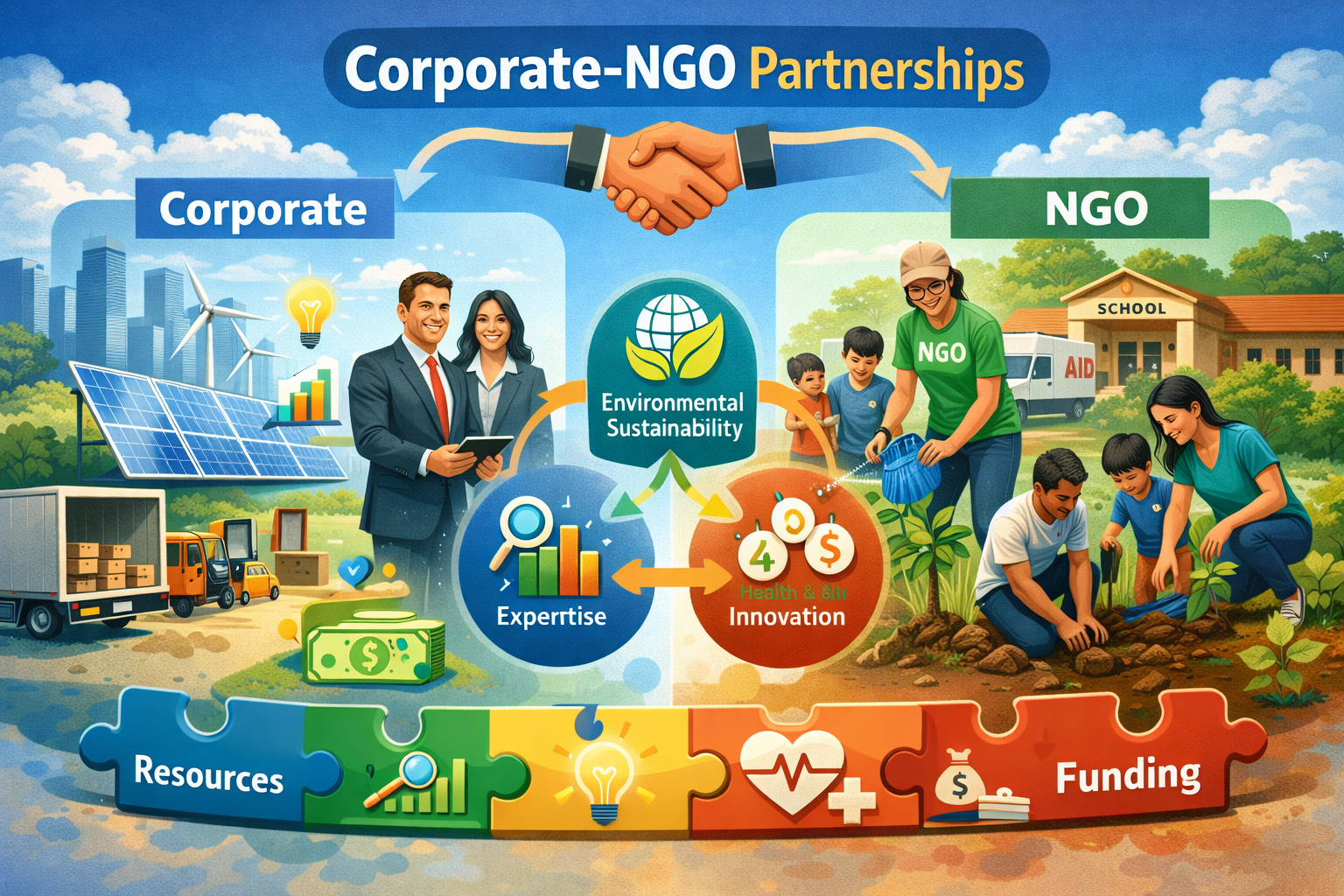
At Manav Vikas Sanstha (MVS India), we firmly believe that a partnership between corporates and NGOs is the solution to existing social development problems. This collaboration is more likely to succeed as it is backed by the combined and complementary strengths of both corporates and NGOs in a structured way.
NGOs with a better knowledge of ground-level challenges clearly understand community realities, including their needs, beliefs, and cultural sensitivities. They know whether a proposed solution will work in a particular region or not because of their years of groundwork. On the other hand, corporates have an upper hand in terms of capital and structured frameworks. They can easily provide stable funding, long-term planning frameworks, and monitoring systems. It’s easier for corporates to expand successful models across regions, so that social development doesn’t remain restricted to only one region.
When NGOs and corporates come together with their unique sets of advantages, results become sustainable rather than short-term. This partnership also enables rapid replication of successful projects, enabling them to be scaled across various socio-economic landscapes nationwide.
The Strength of NGOs: Grassroots Trust and Implementation Expertise
NGOs operate where development actually takes shape, i.e., at the community level, and hence, the role of NGOs in sustainable development always remains important.
For instance, at Manav Vikas Sanstha (MVS India), our grassroots workers have spent years building relationships with local leaders, schools, families, and frontline workers in 19+ Indian states and Union Territories (UTs). This trust has helped us introduce sensitive or complex interventions without resistance.
We believe that people on the ground level are more likely to support and cooperate when they feel heard, connected, and respected. This is why, before going ahead with any project, we first conduct assessments, identify gaps, and accordingly design solutions, and only then do we move towards implementation. We’re immensely proud to share that our social interventions have touched over 25 million lives across India, only because we understood social realities, such as cultural norms, logistical constraints, and behavioural barriers and planned out the initiatives accordingly.
The Strength of Corporations: Funding, Systems, Scale, and Accountability
Corporates enjoy a unique position that enables them to strengthen social initiatives through their financial stability and structured management. Their long-term CSR funding makes it easier for projects to move beyond short pilot phases and operate with continuity. Beyond funding, corporates introduce systems into social development initiatives.
If you explore any CSR project, you’ll find clear objectives, performance indicators, documentation standards, and compliance mechanisms defining the entire project. These systems ensure that every activity is tracked, outcomes are accurately measured, and resources are used efficiently. This approach and system help corporates to scale any project to a larger level.
That’s because when a CSR model proves efficient enough in one location, corporate backing enables expansion across multiple districts and states through planned funding. The combination of capital, governance, and expansion eventually helps transform local impact into responsible and scalable development.
Project GARIMA – A Successful Result of NGO-Corporate Partnership
Anyone who thinks that corporate and NGO partnerships look good only on paper should explore Project GARIMA by Manav Vikas Sanstha (MVS India).
We, being an ISO 9001:2015-certified non-profit organisation, understand the role of NGOs in sustainable development and, hence, have partnered with corporations such as the National Internet Exchange of India (NIXI), GIVE India, Amazon, RAILTEL, and many others to bring about grassroots-level improvements. This partnership led to several successful projects, one of the most notable being Project GARIMA – a project dedicated to improving menstrual hygiene management (MHM) among schoolgirls in government schools.
Menstrual health and hygiene are a critical part of women’s health, but the lack of menstrual hygiene products and safe disposal options affects adolescent girls in numerous ways. Hence, as part of Project GARIMA, we have so far installed around 213 sanitary pad vending machines, along with incinerators for the safe disposal of used pads, in government schools in the districts of Kupwara, Jaisalmer, Baran, Badmer, Baramulla, and many other rural areas across India. The project has already benefitted over 35 Lakh adolescent girls, and has helped to not only mitigate the taboo around menstruation but also enabled them to continue their education journey without the fear of hygiene or sanitation-related issues.
This initiative provided the missing infrastructure to maintain menstrual hygiene, leading to improvements in the overall health of adolescent girls. It also reflected positively on their school attendance and performance. Since sanitary pads were disposed of safely in the incinerators provided by our team, this also created a cleaner, healthier school environment. This is how we at Manav Vikas Sanstha (MVS India), by means of our NGO-corporate partnership, worked towards empowering girls while also creating a positive environmental impact.
Conclusion
Sustainable social development requires far more than mere good intentions. It demands local trust, well-structured funding, and the determination and ability to expand what works. It is precisely what successful corporate-NGO partnerships deliver. They combine the complementary strengths that each institution needs to achieve lasting change.
Since social challenges are much more complex than they appear, isolated efforts will continue to fail. Corporate-NGO partnerships can together navigate the existing challenges in the path of social development, bringing about the results that are both scalable and sustainable.
If you belong to a corporate that wants to utilise its CSR funds wisely, you can partner with us at Manav Vikas Sanstha (MVS India) for bringing about sustainable change in society. We’ve delivered several successful social development projects in partnerships with top corporates, including Asian Paints, HDFC Bank, Indian Oil, Dabur, and Amazon.
You can get in touch with us at +91 8955009377/ +91 9549127666 or hello@mvsindia.org.

All Categories
- Annual Reports (1)
- News (21)
- Projects (9)


Tags
+0123 (456) 7899
contact@example.com