

Can Early Learning Interventions Help Break the Cycle of Poverty?
Overview
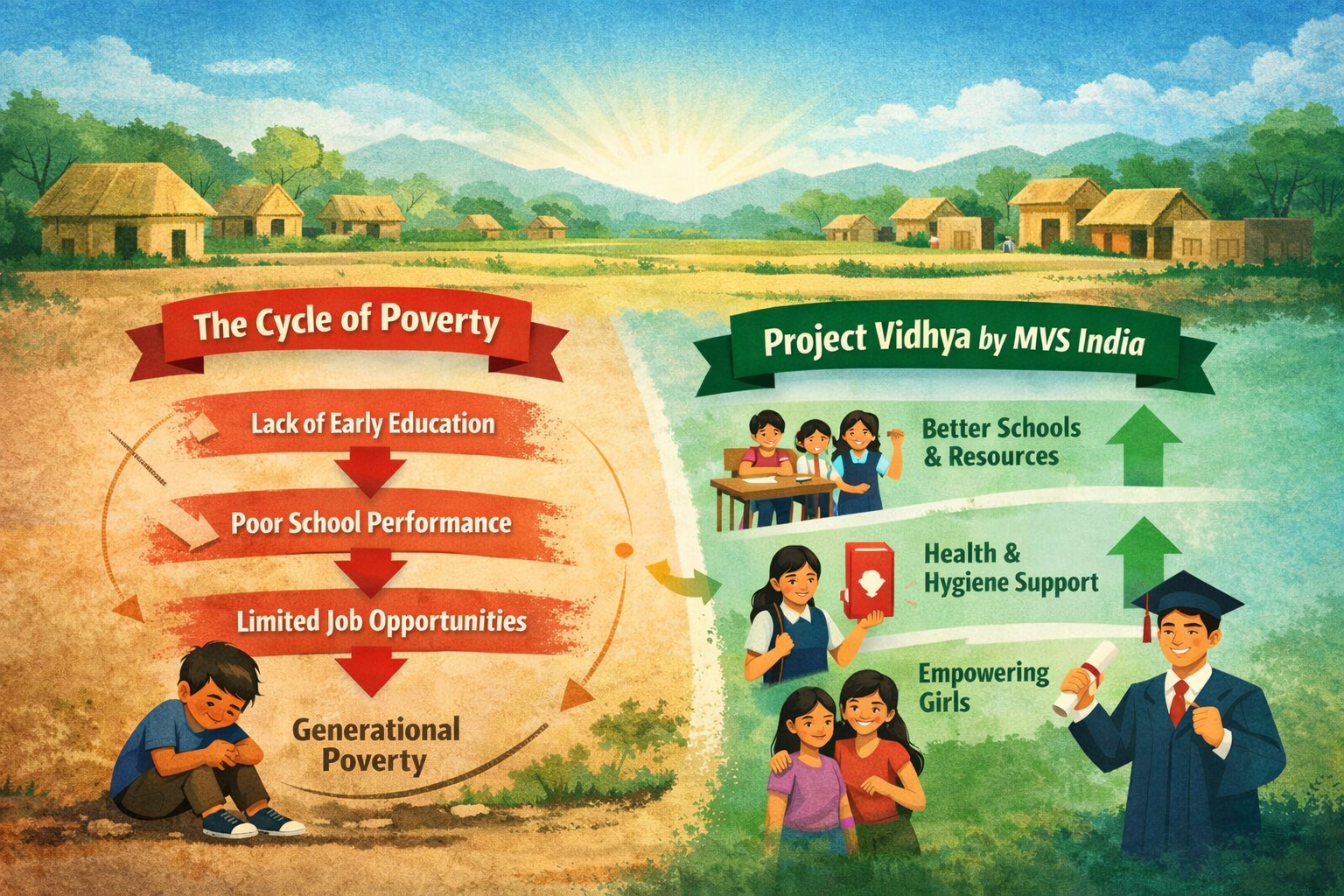
When people talk about poverty, discussions often centre on income, employment, and access to basic services. Yet, long before these factors come into play, disadvantage quietly takes root in early childhood. For millions of children growing up in low-income households in rural regions of India, the absence of quality learning facilities, opportunities, and early support puts a deep impact on their future. This means that by the time their formal schooling begins, many already begin struggling to keep up.
To address the situation, various government and social welfare institutions launch numerous initiatives to help people escape poverty. However, in most cases, these initiatives are introduced too late to achieve lasting improvements in time. This led us at Manav Vikas Sanstha (MVS India), an ISO 9001:2015-certified NGO in Jaipur for education and skill development, to focus on addressing poverty right at its root.
We firmly believe that providing early learning interventions to children from underserved communities can make them eligible for high-income jobs in adulthood. These income opportunities can gradually pull individuals and their families out of poverty cycles. This can eventually create a ripple effect rooted in financial stability.
In this blog post today, we’ve shared how exactly early learning interventions can help break the cycle of poverty and what we at Manav Vikas Sanstha (MVS India) have done in this regard.
Poverty: A Self-Reinforcing Cycle
In India, poverty often reproduces itself across generations – not because of a lack of effort but because of unequal starting points. Children born in underserved regions or low-income households typically grow up in environments where malnutrition is common, learning materials are rare, and emotional security is weak due to financial stress.
These conditions end up shaping the cognitive and social development of these children in ways that are difficult to reverse later. When such children enter formal schooling years, they’re expected to perform at the same level as peers who have had years of improved support. As a result, many students fall behind early.
Once this happens, school becomes a place of struggle rather than growth. Over time, poor academic performance increases the risk of dropout, limits skills development, and narrows employment options. Here, poverty is not a sudden event but a slow accumulation of missed opportunities.
How Weak Early Learning Environments Reinforce Poverty
Despite the emotional and physical hardships faced by children in the underprivileged communities, they don’t lack the intent to make the most of their early learning years. It’s the inadequate conditions at the early learning environments that hold them back.
Lack of proper safety measures, clean drinking water, sanitation facilities, and basic learning resources can badly impact the learning consistency of children. Such unstable learning environments lead to irregular student attendance and a decline in engagement. This disengagement, however, rarely appears sudden. It begins with missed school days that gradually turn into learning gaps, which then lead to frustration and withdrawal.
Over time, education ceases to serve as a pathway out of poverty and instead mirrors the instability of the home environment. Weak early learning environments do not just affect educational outcomes; they also stabilise poverty across generations. All of this led Manav Vikas Sanstha (MVS India) to launch Project Vidhya to address all these issues.
Project Vidhya: An Initiative to Break the Cycle of Poverty
Manav Vikas Sanstha (MVS India), being a well-known NGO in Jaipur for education, introduced Project Vidhya as a CSR initiative to provide quality early-learning interventions in rural areas. This project was conceptualised to enhance school infrastructure, promote digital & scientific education, and support health & hygiene practices. It also placed a special emphasis on empowering girls through menstrual hygiene management (MHM). These are the key areas that need primary attention to improve the school’s learning environment.
Bringing Tangible Improvements at the Grassroots Level
Project Vidhya has already improved learning environments in numerous schools across Rajasthan and Jammu & Kashmir. From renovating school infrastructure to providing adequate learning tools, such as desks and books, Project Vidhya has done much to deliver relevant early learning interventions.
Since adolescent girls were affected the most due to poor learning environments, we prioritised gender sensitisation and menstrual hygiene awareness. This step ensured that young girls don’t miss key school years because of a lack of private, dedicated spaces for managing menstrual hygiene. Also, as a part of Project Vidhya, we installed clean water facilities in schools so that students can benefit from a continuous supply of drinking water.
Collectively, these efforts helped create healthy learning spaces where children from low-income families can receive quality education and develop necessary life skills. They can use the acquired knowledge and skills to land high-paying jobs in adulthood, eventually breaking out of the poverty cycle.
Real World, Real Impact
Under Project Vidhya, the Manav Vikas Sanstha (MVS India) team installed pad vending machines and incinerators at rural schools in the Barmer district of Rajasthan and the Baramulla district of Jammu & Kashmir. This step has helped adolescent girls from low-income families to improve their school attendance and engagement. It even helped improve their academic performance over the months.
We’re currently working to bring similar improvements across 60+ districts in more than 19 Indian states and union territories. Although it’s a long road ahead, our NGO is dedicated to achieving the goal pre-defined in Project Vidhya.
Conclusion
Poverty will continue to pass down from generation to generation until children from one generation take a different route. At Manav Vikas Sanstha (MVS India), a registered member NGO of NITI Aayog and a highly trusted NGO in Jaipur for education, we firmly believe that educating children can bring them closer to high-paying opportunities, helping them escape poverty and breaking the cycle for future generations.
If you share similar beliefs about ending poverty through education, join us in our journey by becoming a part of Project Vidhya. You can volunteer for our project or donate to support the education of underprivileged children so they can sustainably lift themselves out of the poverty loop. Alternatively, you can become our partner and collaborate on launching a new project with similar goals. To connect, you can write to us at hello@mvsindia.org or call us at +91 8955009377/ +91 9549127666.

All Categories
- Annual Reports (1)
- News (21)
- Projects (9)
Tags
+0123 (456) 7899
contact@example.com