

What Is Corporate Social Responsibility (CSR)?
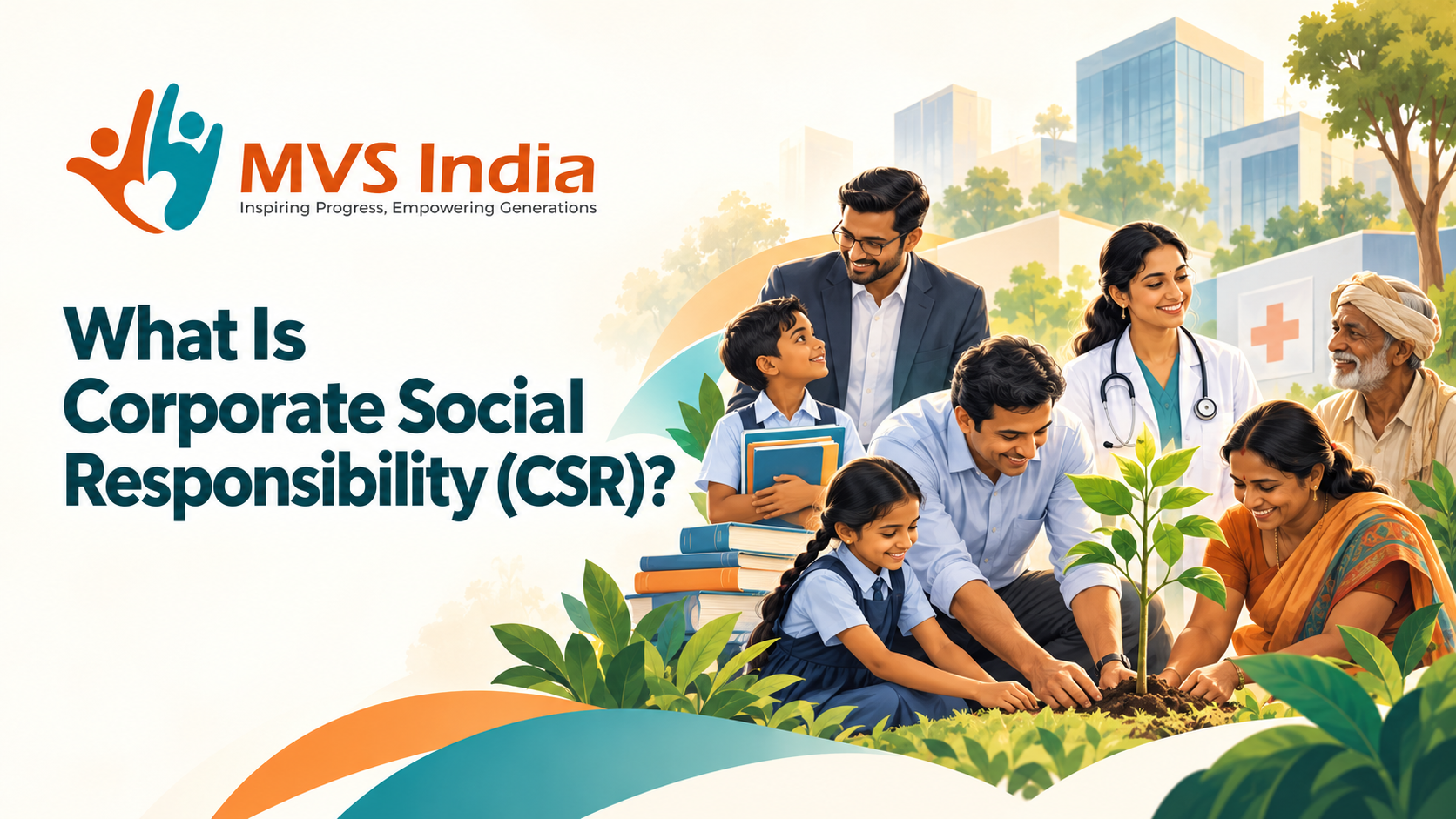
Corporate Social Responsibility (CSR) is a company’s commitment to operating in ways that create value for society and the environment – not just for shareholders.
In simple words: CSR means a business owns up to how its operations affect people, communities, the environment, and other stakeholders – and acts on that responsibility, not just talks about it.
A company might fund a school, run free health camps, cut its water usage, train unemployed youth, or support a village’s sanitation infrastructure. What separates CSR from a one-off good deed is intent and structure: CSR is typically planned, resourced, and structured around defined social or environmental objectives rather than being a one-off act of goodwill.
What Does Corporate Social Responsibility Actually Mean?
Break the term down and it explains itself:
- Corporate– the business or company
- Social– the communities and society it operates within
- Responsibility– being answerable for the effects of its actions
Put together, CSR is a company’s responsibility to look past its balance sheet and ask a second question alongside “how much profit did we make?” – namely, “what did it cost, or create, for the people and environment around us?”
No company operates in a vacuum. It draws on employees, natural resources, local infrastructure, and customer trust to function. CSR is the acknowledgment that this dependency runs both ways.
Why Does CSR Matter?
Business decisions ripple outward. A factory’s water use affects a district’s supply. A tech company’s hiring practices shape a region’s job market. CSR simply asks companies to think about that ripple before it happens, not clean up after.
The priorities differ by industry:
- A manufacturing companytypically looks at waste output, water and energy management, worker safety, and its footprint on nearby communities.
- A technology companyoften focuses on digital literacy, skilling, data responsibility, and access to technology in underserved areas.
- A bank or financial institutionfrequently invests in financial literacy, rural infrastructure, and healthcare access.
This is why CSR isn’t a template – a genuinely effective program starts from what a company’s operations actually touch, not from a generic checklist.
Main Areas of CSR
| CSR Area | What It Looks Like in Practice |
| Education | Scholarships, school infrastructure, digital classrooms, teacher training |
| Healthcare | Medical camps, mobile health units, preventive care programs |
| Environment | Tree plantation, water conservation, waste management, renewable energy |
| Skill Development | Vocational training, digital skills, entrepreneurship programs |
| Women Empowerment | Self-help groups, livelihood training, financial literacy |
| Rural Development | Drinking water, sanitation, village infrastructure |
| Disaster Relief | Emergency response, long-term rehabilitation |
These areas overlap in practice – a rural healthcare project, for instance, often needs sanitation and clean water infrastructure alongside it to actually work.
How CSR Actually Works – Step by Step
CSR fails most often not because the intent is wrong, but because it’s treated as a one-time transaction instead of a managed program. A working CSR cycle looks like this:
- Identify the need– What specific problem exists, and for whom? “Poor education access” is too broad; “Grade 6–8 students lacking science lab access in District X” is workable.
- Design the intervention– What realistic action addresses it, given the company’s resources and expertise?
- Allocate resources– Funding, but also people, technology, and often an implementation partner (see below).
- Implement– Directly, or through an NGO or community organization with on-ground presence.
- Monitor– Is the project actually happening as planned, on schedule, within scope?
- Measure outcomes– Not just spend, but results.
That last step is where most CSR reporting falls short. “We spent ₹50 lakh on education” says nothing about impact. “1,200 students got lab access; test scores in practical exams rose 18% over two years” does. Impact measurement should be built into a project’s design from day one, not bolted on at the end for the annual report.
The Role of Implementation Partners
Most companies aren’t equipped to run a rural health program or a skilling center themselves – nor should they try. This is where NGOs and community organizations come in, contributing local trust, on-ground reach, and domain expertise that a corporate CSR team typically can’t replicate.
A good implementation partnership isn’t just a company writing a cheque to an NGO. It works best when the company stays involved in monitoring and outcome tracking, while the partner handles execution and community relationships. Choosing a credible, capable partner – one with a track record in the specific problem area – is often the single biggest factor in whether a CSR project actually delivers.
Benefits of CSR
For society: better access to education, healthcare, and infrastructure; environmental protection; livelihood opportunities that outlast the project itself.
For the environment: resource conservation, reduced waste, and long-term sustainability practices that ripple beyond the company’s own operations.
For employees: volunteering opportunities and a sense of purpose that often improves retention and morale.
For the company: stronger community relationships, better regulatory standing, reduced reputational risk, and – increasingly – favor with ESG-conscious investors.
One caution: CSR that exists purely to generate marketing content rarely produces lasting impact. The programs that work are the ones designed around a genuine, specific need – not around what photographs well.
CSR vs. Charity: What’s the Real Difference?
| CSR | Charity |
| Structured, ongoing programs | Often one-time or occasional giving |
| Tied to a broader responsibility strategy | Usually focused on a specific cause or moment |
| Frequently includes outcome measurement | Rarely tracks long-term impact |
| Can be legally mandated (India) | Always voluntary |
A company donating relief funds after a flood is charity. A company building flood-resilient infrastructure in that same district over three years, with measured outcomes, is CSR. The line isn’t always sharp, but intent and structure are the deciding factors.
CSR vs. ESG: Not the Same Thing
CSR and ESG get used interchangeably, but they answer different questions:
- CSRasks: what social and environmental initiatives is this company running?
- ESG(Environmental, Social, Governance) asks: how do we evaluate a company’s performance and risk across these dimensions – often for investors?
CSR is the action; ESG is closer to the scorecard. There’s real overlap – a strong CSR program often improves ESG scores – but treating them as synonyms misses the point of both.
CSR in India: The Legal Framework
India is one of the few countries where CSR spending isn’t purely voluntary. The Companies Act, 2013 requires companies that meet specified financial thresholds to spend a set percentage of average net profit on CSR, following eligible activities listed under Schedule VII. Companies must also form a CSR committee and disclose their spending in annual reports.
Because thresholds, percentages, and eligible activities are periodically updated, always verify current figures directly with the Ministry of Corporate Affairs (MCA) before citing specific numbers or compliance requirements – this is not the kind of detail worth guessing on.
Common Challenges in CSR
- Picking the wrong project– one that sounds impactful but doesn’t address the community’s actual priority
- Weak impact measurement– tracking spend instead of outcomes
- Low community involvement– projects designed for a community instead of with it tend to underperform
- Short-term thinking– many social problems (education, health outcomes) need years of sustained work, not a single-year grant cycle
- Choosing the wrong partner– an under-resourced or inexperienced implementation partner can sink an otherwise well-designed program
Frequently Asked Questions
What is CSR in simple words?
CSR means a company takes responsibility for how its business affects society and the environment, and acts on that responsibility through structured programs – not just profit-making.
What is the full form of CSR?
Corporate Social Responsibility.
Is CSR only about donating money?
No. Donations are one form, but CSR more often involves long-term, planned programs in education, healthcare, environment, or skilling – with defined goals and measured outcomes.
Is CSR mandatory in India?
Yes, for companies meeting specific financial thresholds under the Companies Act, 2013 – verify current thresholds with the MCA.
What’s the difference between CSR and ESG?
CSR is the initiatives a company runs; ESG is the framework used to evaluate a company’s environmental, social, and governance performance.
Final Thought
Corporate Social Responsibility is more than a company donating money or publishing a sustainability report. It is about understanding how business decisions affect people, communities, and the environment-and taking meaningful action in response. Effective CSR begins with a genuine need, clear objectives, responsible implementation, and measurable outcomes. Whether a company supports education, improves healthcare, protects natural resources, or creates employment opportunities, the real value lies in the impact it creates. Ultimately, CSR should not be measured only by how much a company spends, but by what changes because of that effort and whether those changes create lasting value for society.

All Categories
- Annual Reports (1)
- News (28)
- Projects (9)


Tags
+0123 (456) 7899
contact@example.com