

Healthcare NGO in India: Working to Improve Public Health
Health camps, diagnostic support, preventive care and community outreach — delivered where healthcare access is thinnest.
Bringing Essential Healthcare Closer to Underserved Communities
Access to quality healthcare remains one of the biggest challenges across public health in India, particularly in rural and underserved communities. While cities benefit from hospitals, specialists, and advanced diagnostic facilities, many villages still struggle to access even basic primary healthcare services. Bridging this gap requires community-driven healthcare solutions that reach people where they live.
As a trusted healthcare NGO in India, MVS works to strengthen public health in India through health camps, diagnostic support, preventive healthcare, and community outreach programs. Our initiatives focus on improving rural healthcare in India by bringing essential healthcare services closer to underserved communities across Rajasthan and other regions, helping create healthier and more resilient communities.
What Is a Healthcare NGO in India?
A healthcare NGO in India is a non-profit organisation that works to improve access to medical services, health awareness, and preventive care for underserved communities. Unlike a hospital or clinic, it doesn’t primarily treat illness — it works upstream, through screening, education, and outreach, in areas where government health centres are understaffed, under-equipped, or simply too far away.
At MVS, this means combining direct field implementation with structured community outreach, so that health support actually reaches people rather than staying on paper.

Why Public Health in India Needs Stronger NGO Support
Public health in India faces real structural gaps. National doctor and nurse density remains well below the WHO – recommended benchmark, and the shortfall is far steeper in rural areas – recent government data shows nearly 80% of specialist posts at rural Community Health Centres are vacant. Most rural households still travel long distances for basic diagnosis, and a large share of medical costs are paid out of pocket.
At the same time, India carries a double burden of disease — tuberculosis and malaria remain widespread even as lifestyle conditions like diabetes and hypertension rise sharply. Add maternal and child health gaps, malnutrition, and low awareness of preventive care, and the need for community-level intervention becomes clear.
This is exactly where a public health NGO in India can help — not by replacing the government health system, but by strengthening it at the last mile.
of specialist posts at rural Community Health Centres are vacant
Recent government data
of India’s population lives in rural areas
Where health infrastructure is thinnest
Rural Healthcare in India: The Last-Mile Challenge
More than 60% of India’s population lives in rural areas, where healthcare infrastructure remains thin compared to cities. Long travel distances, a shortage of specialists, and limited diagnostic access often delay treatment until a condition becomes serious.
Improving rural healthcare in India takes more than building hospitals – it needs community engagement, regular screening, and health education delivered close to where people actually live. MVS works at this grassroots level, bringing care closer to home rather than expecting people to travel toward it.
Our Public Health Programs
As a trusted healthcare NGO in India, MVS implements community-based programs that improve public health in India through preventive care, health awareness, and better access to essential healthcare services. Rather than focusing on a single activity, our integrated approach addresses multiple aspects of rural healthcare in India, helping communities achieve better long-term health outcomes.
Project AAROGYYA
Health Camps and Diagnostic Support
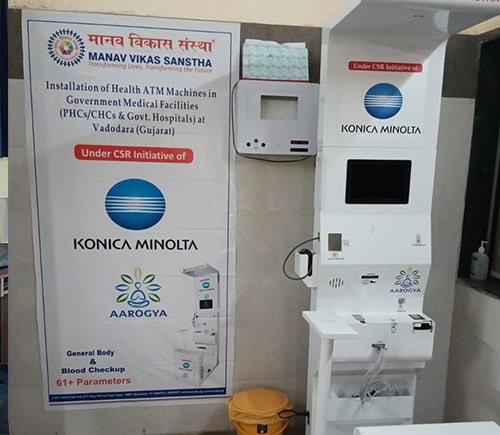
We organise community health camps, basic medical check-ups, and Health ATM diagnostic services that make primary healthcare and early disease screening accessible to underserved communities.
Project GARIMA
Menstrual Health and Hygiene
Promotes menstrual hygiene awareness among adolescent girls by providing sanitary products, safe disposal solutions, and health education, helping improve health, dignity, and school attendance.
Nutrition and Child Health
Our nutrition initiatives focus on reducing malnutrition among children and mothers through growth monitoring, nutrition counselling, health education, and community-based interventions.
Preventive Healthcare Awareness
We conduct awareness campaigns on hygiene, sanitation, safe drinking water, vaccination, and disease prevention to encourage healthier lifestyles and reduce the burden of preventable illnesses.
Maternal and Child Health
Our outreach programs support maternal and child wellbeing by promoting antenatal care, early childhood nutrition, immunisation awareness, and safe pregnancy practices within local communities.
These initiatives are designed to strengthen community healthcare, improve healthcare access, and create sustainable improvements in public health in India through grassroots engagement and long-term community partnerships.
MVS India’s Approach to Healthcare Programs
Every healthcare project follows a structured process rather than a one-off camp. It starts with an on-ground need assessment to understand the actual health gaps in an area, followed by project design, field implementation, and continuous monitoring. Every project closes with an impact review, so outcomes are measured, not assumed.
This structure matters most for corporates funding CSR health projects under Schedule VII of the Companies Act — it allows for transparent reporting and measurable community impact, instead of a health camp with no long-term tracking.

Need Assessment
On-ground study of the actual health gaps in an area
Project Design
A programme built around those specific gaps
Field Implementation
Delivery through local teams and community institutions
Continuous Monitoring
Ongoing field supervision and documentation
Impact Review
Outcomes measured at close, not assumed
What to Check Before Choosing a Healthcare NGO in India
Not every organisation running the occasional health camp can deliver sustained impact. Before partnering with a healthcare NGO in India, it’s worth verifying:
- Valid 12A and 80G registration, and FCRA status if the project involves foreign funding
- A documented track record of health programs, not just proposals or one-time events
- Field capacity — an actual team on the ground, not a consulting layer alone
- A clear monitoring and impact reporting process suited to CSR compliance needs
MVS meets each of these markers, backed by direct, on-ground experience running health programs across districts in Rajasthan.
Why Partner with MVS as Your Healthcare NGO in India
Unlike organisations that run occasional, disconnected health camps, MVS structures its programs around continuous engagement, monitoring, and reporting. That makes us a reliable partner for corporates, donors, and government bodies looking to support public health in India through credible, accountable channels.
Partner with MVS to run health programs that create measurable, lasting impact.
- Free consultation to scope your healthcare CSR project
- Schedule VII-aligned proposals with transparent budgeting
- On-ground execution across Rajasthan, North India, and North-East India
- Impact reporting built for CSR compliance and board review
Let’s Improve Health Access Together
Tell us your CSR focus area and budget, and we’ll come back with a Schedule VII-aligned healthcare programme designed around real community need.
Frequently Asked Questions
What does a healthcare NGO in India actually do?
A healthcare NGO in India improves access to medical services for underserved communities through health camps, diagnostic support, awareness programs, and preventive care — often filling gaps government infrastructure can’t fully cover alone.
How is a public health NGO different from a hospital or clinic?
A public health NGO focuses on prevention, awareness, and community-level access rather than direct treatment. It works upstream of illness, through education, screening, and outreach, reducing the overall burden on the formal healthcare system.
What are the biggest public health challenges in India today?
India deals with infectious diseases like tuberculosis and malaria, rising non-communicable diseases such as diabetes and hypertension, maternal and child health gaps, and a shortage of doctors and health infrastructure in rural areas.
Why is rural healthcare in India especially difficult to deliver?
Rural communities face long travel distances, a shortage of specialists, and limited diagnostic facilities, which often delay treatment. Strengthening rural healthcare requires community engagement and services delivered close to home, not just more hospital beds.
How does MVS India select the communities it works in?
MVS India conducts an on-ground need assessment before starting any project, identifying real health gaps in a district or community, and designs programs suited to those needs rather than applying one generic model everywhere.
Can corporates fund MVS India’s healthcare programs as part of CSR?
Yes. MVS India partners with corporates to implement healthcare and public health projects under Section 135 and Schedule VII of the Companies Act, with structured reporting and impact assessment suited for CSR compliance.