

Why Digital Healthcare is the Need of the Hour for India’s Border Communities?
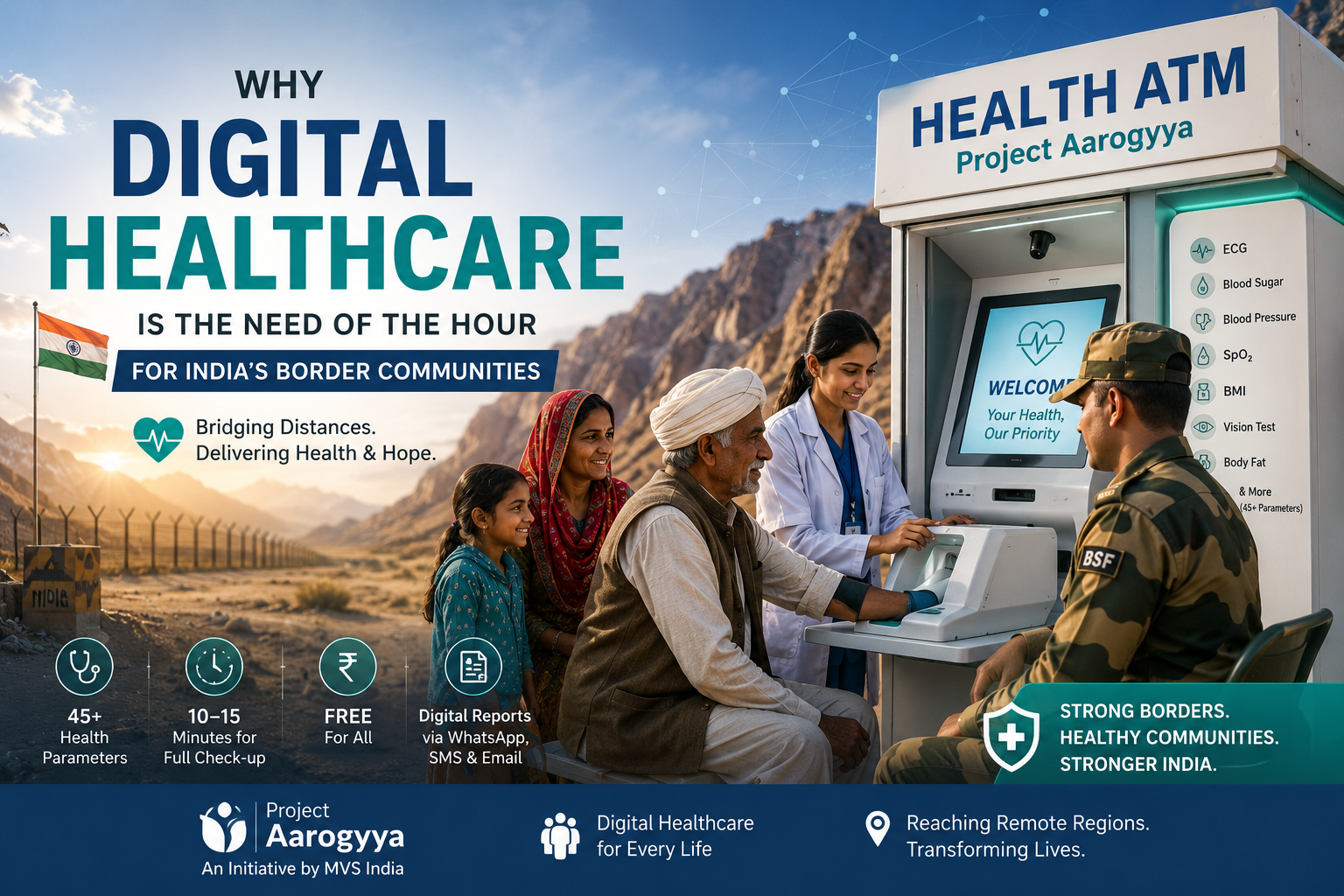
For many people living in Indian cities, healthcare is often a matter of convenience. While urban regions can be relied on for quality healthcare, easy access to diagnostic centres, faster access to specialists, and shorter waiting times, none of it is available to India’s rural areas, especially the border communities. Yes, government facilities are available, but it’s challenging to find a decent team of specialists, diagnostic facilities, and enough trained staff to cater to border communities properly.
Hence, we at Manav Vikas Sanstha (MVS India), an ISO 9001:2015 Certified NGO in Jaipur, launched Project Aarogyya to address this gap. Through Project Aarogyya, we’re making digital healthcare accessible to the regions where it’s required the most, i.e. Indian border communities. If you’re curious to learn more, read the full blog post.
The Healthcare Reality in India’s Border Areas
If you visit India’s border regions, such as the Uttarakhand border belts, Rajasthan desert borders, Ladakh, Arunachal Pradesh, and Nagaland, you’ll notice a common challenge regarding healthcare accessibility. Border communities living in these areas usually struggle with a shortage of doctors, specialists, and diagnostic centres.
Families living in remote areas must travel to nearby larger towns or cities to get certain diagnostic tests done and consult specialists for chronic health conditions. This travel usually involves long road journeys, high transportation costs, and physical strain, which is not feasible for everyone. This visible gap in healthcare access significantly affects border communities.
We’re filling this gap by introducing digital healthcare facilities in India’s border regions. Currently, we’ve made digital healthcare accessible in remote regions in Punjab, Rajasthan, Sikkim, Ladakh, Gujarat, Mizoram, Goa, Uttar Pradesh, Assam, and Tripura, and we’re constantly working to expand the reach further.
Why Digital Healthcare is Necessary for India’s Border Communities?
Some people question the relevance of introducing digital healthcare when traditional infrastructure could have also been built. While building hospitals and diagnostic facilities is crucial, sustaining them in remote, low-population areas is challenging. Additionally, retaining specialists in geographically remote areas has been another long-standing challenge for authorities.
A digital healthcare infrastructure can solve most of these root problems. For example, we’ve installed approximately 57 health ATMs as part of our digital healthcare initiative across multiple Indian states and union territories. These ATMs can conduct health diagnosis across 45+ parameters. The accuracy of the diagnosis is extremely high, and it can be finished within 10-15 minutes.
Since these health ATMs can handle heavy patient flow for diagnosis due to their speed and accuracy, border communities no longer have to travel to distant towns or cities to access healthcare services. It’s also helping people living near border regions with preventive healthcare, so chronic conditions can be identified and treated well in time.
Project Aarogyya: Digital Healthcare Initiative India’s Border Communities Needed
In India’s border regions, primary and community healthcare centres were available, but only a few of them had proper diagnostic labs. The service quality gap was also glaringly visible, as it was challenging to retain highly trained medical staff in such remote locations.
Border communities belonging to low-income groups faced additional hardship with healthcare access, as available diagnostic and primary healthcare services were beyond their financial means. Hence, we at Manav Vikas Sanstha (MVS India), positioned among the top 10 NGOs in Jaipur, introduced Project Aarogyya in border regions to address all these challenges.
As a part of this project, our team has installed health ATMs in these regions. FDA & CE-certified diagnostic kiosks can conduct diagnostic tests against 45+ health parameters, such as:
- Blood sugar
- ECG
- BMI
- Blood pressure
- Lipid profile
- SpO2
- Far and near vision
- Body FAT analysis and more
How Do These Health ATMs Work?
The best part about our health ATMs is that they do the job of multiple diagnostic tools without compromising accuracy. Since it’s free, people from low-income communities can also get their routine health check-ups done without worrying about the fee.
A trained operator is always present to assist patients with their diagnosis. People can simply register using their mobile number, health ID, etc., and get tests done within a few minutes. Since the diagnosis report can be shared digitally via WhatsApp, SMS, and email, patients can easily share it with specialists for further treatment.
MVS India & NIIF IFL’s CSR Initiative: Bringing Smart Digital Healthcare to Indian Borders
In the past, Manav Vikas Sanstha (MVS India) has partnered with numerous Indian businesses to democratise access to quality healthcare in India’s rural regions. But one of our most notable recent collaborations has been with NIIF Infrastructure Finance Limited for their CSR initiative.
Under this partnership, we installed health ATMs at seven BSF border outposts along the India-Pakistan international border.
It was for the first time that such a healthcare facility was installed in:
- Sector Hospital, BSF Sector Headquarters, Jaisalmer North
- Unit Hospital, 192 Battalion BSF
- Mini Hospital, BOP Bharewala, 72 Battalion BSF
- Unit Hospital, 126 Battalion BSF
- Mini Hospital, OPS Base K.C. Katoch, 38 Battalion BSF
- Sector Hospital, BSF Sector Headquarters Jaisalmer South (122 Battalion)
- Mini Hospital, Tanot, 26 Battalion BSF Jaisalmer North
These health ATMs will ensure that BSF jawans posted to these locations have easy, quick access to quality healthcare services. We firmly believe these installations will assist jawans with preventive healthcare, enabling them to maintain excellent health throughout.
We’ve also installed multiple health ATMs in other rural regions of Shravasti (Uttar Pradesh), Nagaon (Assam), West Tripura (Tripura), Bathinda (Punjab), and other areas, so border communities can enjoy free access to quality healthcare and diagnostic services.
Conclusion
For India’s border communities, digital healthcare isn’t just about embracing a new technology. You can view it as a tool to make quality healthcare widely accessible in places where geography continues to limit timely medical support. Countless families living near border regions struggle to find affordable yet high-quality healthcare services.
We at Manav Vikas Sanstha (MVS India), a well-known NGO in Jaipur, Rajasthan, are bringing India’s border communities and jawans closer to reliable healthcare and diagnostic services through our Project Aarogyya. Our team firmly believes that installing health ATMs will benefit rural families living in border regions as well as BSF jawans by providing them easy access to preventive healthcare and routine health monitoring.
If you believe everyone has a right to quality healthcare, you can be part of our Project Aarogyya as a volunteer or by donating to our cause. Businesses planning to align their CSR initiative with this project also contact us at +91 8955009377/ +91 9549127666. You can also write to us at hello@mvsindia.org.

All Categories
- Annual Reports (1)
- News (25)
- Projects (9)
- Resources (1)
Tags
+0123 (456) 7899
contact@example.com